Read More
India has emerged as one of the most promising destinations to invest in startups, driven by rapid digital growth and a large, young population. As per the Ministry of Commerce &...
Legally wind up your company in India with Startupease expert guidance. We handle ROC filings, board resolutions, final accounts, and complete compliance for Private Limited, LLP, and OPC entities.
 Process Initiation in 7–10 DaysBoard & Shareholder Resolution DraftingROC Filing & Legal Documentation SupportFinal Accounts Preparation & ClearancesTrusted by 2,000+ Businesses
Over 17,600 companies were closed till January 26 alone in India. Shutting down a business in India happens more often than you'd expect, whether because of loss of capital, evolving markets, or moving on to new opportunities. However, the process of closing a company is anything but easy.
For small business owners and individuals in India, understanding the formal process of closing a company is crucial. This procedure, known as winding up, ensures a legal and orderly conclusion to a company's existence. It protects the interests of all parties involved, from creditors to employees and shareholders.
The process can seem overwhelming. It involves filing the correct documents, understanding complex legal provisions, and ensuring full compliance with the Companies Act, 2013.
Winding up represents the formal process of bringing a company's business operations to a close. It signifies the lawful end of a corporate entity's life. The process involves several key actions:
In India, the Companies Act, 2013, and the Insolvency and Bankruptcy Code (IBC), 2016, primarily govern this entire procedure. A professional, referred to as a liquidator, is appointed to oversee and manage this complex process.
Throughout the winding-up process, the company retains its legal identity and can continue to participate in legal proceedings.
Indian law offers different ways to close a company, depending on its situation and financial condition:
This occurs when a court or tribunal mandates the company's closure. In India, the power to wind up a company lies with the National Company Law Tribunal (NCLT), as explained in Section 271 of the Companies Act, 2013. The process typically begins with a formal petition filed before the NCLT.
Here’s who can file such a petition:
The grounds include the company's inability to pay its debts. This is presumed if a creditor's demand for payment (exceeding ₹1 lakh) remains unsettled for 21 days. Other grounds include:
If the NCLT finds a valid case, it admits the petition and appoints an official liquidator.
Voluntary winding up is initiated by the company's members (shareholders) or creditors, without direct court intervention. This self-initiated procedure typically begins with the company passing a special resolution in a general meeting.
There are two distinct forms of voluntary winding up:
A solvent company capable of paying its debts can use the voluntary winding-up process with minimal court involvement. However, if a company is insolvent and cannot pay its debts, the process requires stronger creditor protections, leading to a compulsory winding up or a creditors’ voluntary winding up.
The winding-up process includes several important elements to ensure it’s done legally and in an organized way.
These terms are often used interchangeably, but they represent distinct stages in the process of closing a company.
| Particulars | Winding-up | Dissolution | Liquidation |
| Meaning | The process of settling a company's affairs by selling assets, paying debts, and distributing surplus. | The final act of ending the company's existence legally. | The process of converting assets into cash (realization) and distributing them to creditors and members. Often synonymous with winding up. |
| Process | The process that leads to a company's dissolution. | The end process/result of winding up and getting the name struck off from the Register of Companies. | The process ends with the removal of a company’s existence as a legal entity. |
| Existence of Company | The legal entity of the company continues and exists at the commencement and during the winding-up process. | The dissolution of the company brings an end to its legal entity status. | The company continues to exist as a legal entity during this process. |
| Continuation of Business | A company can be allowed to continue its business during the winding-up process if beneficial. | The company ceases to exist upon its dissolution. | The company ceases to exist after liquidation. |
| Moderator | The liquidator carries out the process of winding up. | The NCLT passes the order of dissolution, or the ROC strikes off the name. | The liquidator is appointed to manage the process of liquidation. |
| Activities Included | Filing resolution/petition, liquidator appointment, declarations, reports, disclosures, and filing for dissolution. | The final order by the NCLT or action by the ROC that legally terminates the company's existence. | Selling assets, collecting debts, paying creditors, and distributing remaining funds. |
The winding up of companies in India is primarily governed by two key legislative frameworks:
This Act provides a comprehensive structure for winding up procedures, particularly under Chapter XX (Sections 270 to 365). It outlines provisions for both compulsory winding up by the Tribunal and, historically, voluntary winding up.
However, after the enforcement of the Insolvency and Bankruptcy Code (IBC), 2016, most provisions related to voluntary winding up under the Companies Act have been omitted or made inapplicable. As of now, only winding up by the Tribunal continues to be governed under the Companies Act, 2013 (specifically under Section 271 and onwards).
With its enactment, the IBC, particularly Section 59, now largely governs voluntary liquidation for corporate persons. The IBC focuses on making the resolution process faster and more efficient. It also covers compulsory liquidation procedures, especially when a company is unable to pay its debts.
Winding up a company, while signifying an end, offers several advantages, particularly when a business is no longer viable or has served its purpose.
[caption id="attachment_11500" align="alignnone" width="2560"]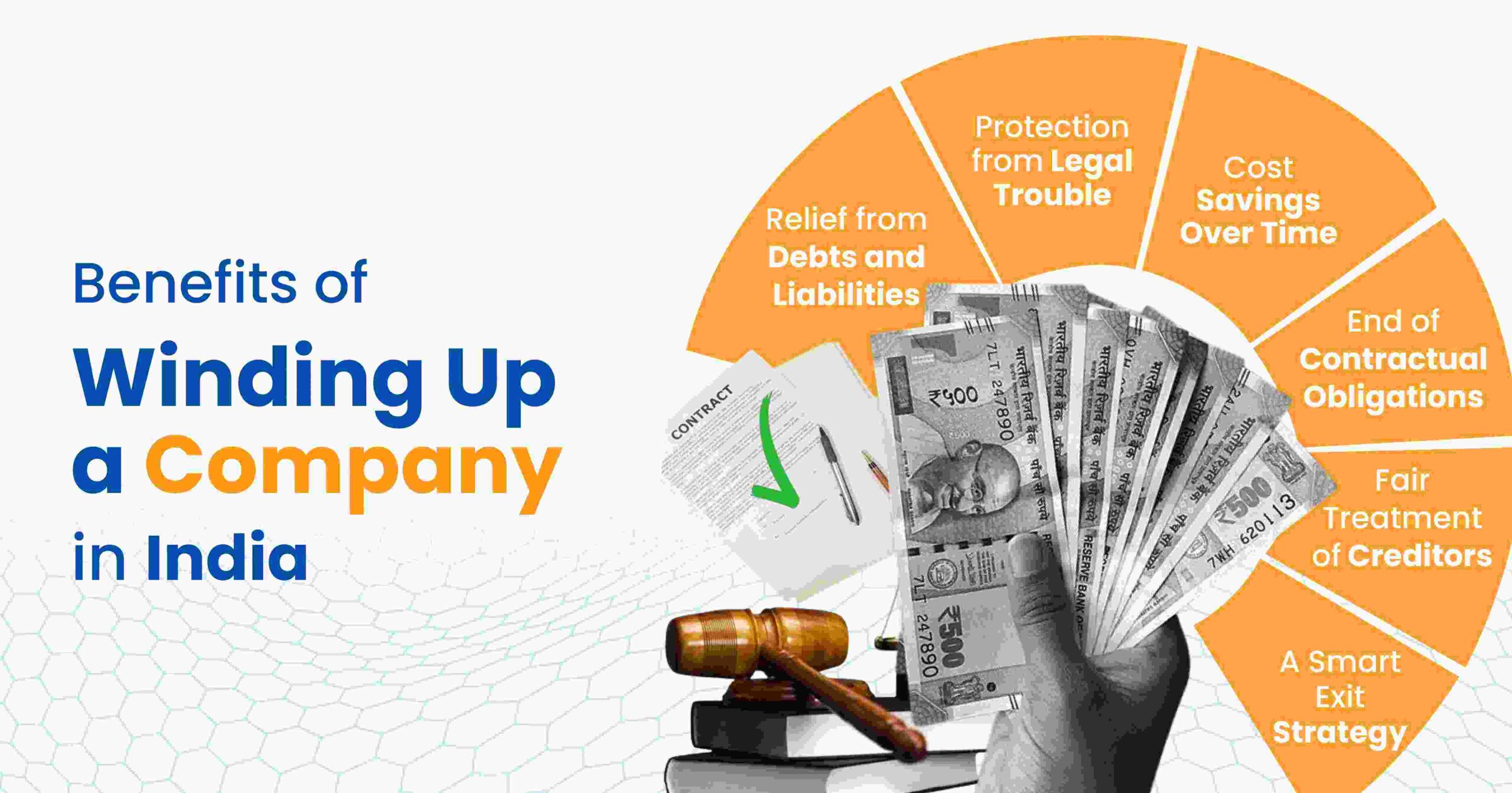
Once the liquidation process is completed, the company’s directors and administrators are no longer responsible for settling debts or dealing with creditors.
This allows them to move forward with a fresh start, free from previous financial stress.
Choosing voluntary winding up can help a company avoid possible legal action from courts or regulatory bodies due to ongoing non-compliance or financial issues.
This proactive decision lets directors shift focus to new business ideas without worrying about old legal problems.
Keeping an inactive or non-operational company still comes with regular costs, such as filing fees and audit expenses.
Liquidation puts an end to these yearly costs, helping save money in the long run.
Often, the expenses involved in winding up are covered by selling off company assets, making it more affordable than continuous compliance.
During the winding-up process, certain long-term agreements—like leases—can be canceled.
This helps the company stop paying for contracts it no longer needs.
Liquidation follows a set process that ensures creditors are notified and their claims are handled in a fair and transparent manner.
Creditors can assess the situation based on official credit statements and prepare for any shortfalls.
Winding up a company that is inactive or not profitable can be a strategic move.
It reduces legal and financial pressure, giving directors and shareholders a chance to explore fresh opportunities without being tied to past obligations.
While winding up offers benefits, it also carries significant disadvantages for the company and its stakeholders.
Once a company is dissolved, it loses its legal status and is no longer recognized as a separate legal entity.
It cannot sign contracts, enter into civil transactions, or take part in legal proceedings.
The main goal of liquidation is to sell the company’s assets and use the proceeds to pay off debts. Creditors are paid first, including employees and government dues.
Shareholders receive money only if there’s anything left after all debts are cleared. If the company’s assets are not enough, creditors may get only a part of what they are owed.
If the company is wound up due to a creditor’s petition, it can signal financial distress or insolvency. This may harm the company's creditworthiness and public reputation.
It could also lead to loss of customers and defaulting on other obligations, worsening the financial situation.
Once a winding-up petition is filed, the company cannot sell or transfer assets without court approval.
Directors may face legal action if they commit fraud or attempt to hide assets during the process.
All pending tax dues, such as income tax and GST, must be cleared during the winding-up process.
The liquidator may need a tax clearance certificate before the company can be officially closed.
In most cases, directors are not personally responsible for the company’s debts unless they:
The Supreme Court has clarified that directors' liability usually begins after a winding-up order is issued. If fraud is found, directors can be held personally responsible for the company's losses.
According to Section 272 of the Companies Act, 2013, a petition for winding up can be presented to the Tribunal by:
This broad range of petitioners ensures that various stakeholders, including regulatory bodies, have the means to initiate a winding-up process when necessary.
The specific documents required depend on the mode of winding up, but a general set of documents is common.
The following documents are generally required for closing a company in India:
For specific voluntary winding up, the following additional documents might be required:
The documents mentioned below would be required for the compulsory winding up of a company:
Ensuring all documents are accurate and complete is paramount to avoid delays and complications in the winding-up process.
The process for winding up a company varies significantly between voluntary and compulsory modes.
This process is self-initiated by the company, typically for solvent entities.
The Board of Directors must pass a resolution recommending voluntary liquidation and appointing a liquidator, followed by a special resolution by shareholders within 4 weeks.
A declaration of solvency must affirm that the company has no debt or will be able to pay off debts in full. A valuation report is optional unless assets need to be valued under applicable accounting standards.
Within four weeks of the Declaration of Solvency, the company holds a general meeting. Shareholders pass a special resolution to wind up the company voluntarily and appoint an Insolvency Professional as the liquidator.
If the company has debts, creditors who hold at least two-thirds of the total amount must approve the resolution within 7 days. The liquidation process officially begins from the date this resolution is passed.
The company must notify the Registrar of Companies (ROC) and the Insolvency and Bankruptcy Board of India (IBBI) within 7 days of passing the members' resolution (or creditors' approval, if required). This involves filing Form MGT-14 and Form GNL-2 with the ROC.
It’s also crucial to notify IBBI about the initiation of liquidation in Form A under the IBBI (Voluntary Liquidation Process) Regulations, 2017.
The appointed liquidator must make a public announcement within 5 days in Form A, calling for claims from stakeholders. It must be published in one English and one regional language newspaper, and on the company’s and IBBI’s websites.
The liquidator takes custody of assets, sells them, and collects any outstanding dues. They verify claims from creditors within 30 days of the last date for receipt of claims and prepare a list of stakeholders.
Proceeds are distributed to stakeholders within 30 days of receipt, after deducting liquidation costs.
Upon completing the liquidation, the liquidator prepares a final report, including audited accounts. This report is submitted to the Adjudicating Authority (NCLT), along with an application for dissolution.
The NCLT then passes an order dissolving the company. A copy of this order is forwarded to the ROC within 14 days.
This court-supervised process is typically initiated when a company is unable to meet its obligations or has acted unlawfully.
An eligible petitioner (company, creditor, contributory, ROC, or government) files a formal petition with the NCLT bench having jurisdiction over the company's registered office. The petition must be in Form WIN 1 or WIN 2, accompanied by an affidavit in Form WIN 3.
A detailed statement of the company's affairs (Form WIN 4) must also be submitted within 30 days.
The NCLT scrutinizes the petition. The petition must be advertised in an English and vernacular newspaper circulating in the state where the company's registered office is located.
It should be in Form WIN 6 and published at least 14 days before the hearing.
The Tribunal may appoint a provisional liquidator to take charge of the company's assets and affairs until a final winding-up order is made.
The NCLT hears the petition and may pass an order for winding up. The order for winding up is sent to the Company Liquidator and the ROC within 7 days.
The Tribunal appoints an official liquidator to oversee and manage the winding-up process. The liquidator takes custody of all company assets and documents. They prepare a preliminary report within 60 days and investigate the company's affairs, reporting any fraud.
The liquidator liquidates assets and calls upon creditors to prove their claims within 30 days of appointment. A list of creditors is filed with the Central Government within 30 days of the expiry of the claim. The liquidator then discharges dues according to priority.
After winding up the company's affairs, the liquidator makes an application to the NCLT for dissolution. If the NCLT finds the accounts in order, it passes a dissolution order, typically within 60 days of receiving the application. A copy of this order is forwarded to the ROC within 30 days. The ROC then formally dissolves the company by removing its name from the register.
Understanding the costs and potential penalties is crucial for any business owner considering winding up.
The cost of closing a company in India varies significantly based on the chosen method:
Other Miscellaneous Costs: These can include:
Unexpected legal costs can vary significantly based on complexity.
Many directors mistakenly believe that "no operations mean no obligations" for inactive companies. This misconception can lead to severe financial and legal consequences.
Inactive companies are still required to file annual returns (MGT-7/MGT-7A) and financial statements (AOC-4). Failing to do so attracts significant penalties under Section 92(5) of the Companies Act, 2013.
If directors don’t file financial statements and annual returns for three years in a row, they can be disqualified for five years from becoming or continuing as a director in any company, as per Section 164(2)(a) of the Companies Act, 2013.
This means they cannot start new companies or be part of existing ones during that period.
Remaining registered but inactive exposes directors to laws dealing with Benami Transactions and Corruption. The government is serious about companies that have not filed returns, leading to suspicion from central agencies.
Prosecution of directors under the Companies Act for failing to meet statutory obligations is possible.
The duration of the winding-up process varies significantly based on the chosen method and the complexity of the company's affairs.
| Type of Closure | Applicable To | Average Duration | Key Details |
| Voluntary Striking Off (Fast Track Exit - STK-2) | Defunct companies with little or no liabilities | 60 to 90 days | Now faster due to improved processing systems. |
| Voluntary Liquidation (IBC, Section 59) | Solvent companies choosing voluntary closure | 6 to 12 months | Depends on asset sale and creditor settlement- No claims: ~90 days- With claims: up to 270 days |
| Compulsory Winding Up (Tribunal-led - NCLT) | Insolvent or disputed companies via court order | 1.5 to 2+ years (can vary) | NCLT aims to pass orders within 90 days, but the overall process can take 12–18 months. |
The timelines are estimates and can be impacted by factors such as the number of creditors, the complexity of assets, and any disputes among stakeholders.
Companies wind up for various reasons, ranging from financial distress to strategic business decisions.
These reasons highlight that winding up is not always a sign of failure but can also be a strategic and responsible decision to conclude a business entity's life.
Connect with Startupease and let our experts handle
the legal hassle while you grow your business.