
Read More
India has emerged as one of the most promising destinations to invest in startups, driven by rapid digital growth and a large, young population. As per the Ministry of Commerce &...
Avoid penalties and last-minute stress with reliable GSTR-9 return filing. Stay compliant with GST laws and ensure your business meets all regulatory requirements before the due date. What you get:
 Expert-Led GSTR-9 Filing SupportAccurate Computation & ReconciliationGSTIN-Level Reporting & ValidationCA-Reviewed for AccuracyTrusted by 20,000+ Businesses & Professionals
GSTR-9 is an annual return that GST-registered persons are required to submit at the close of every financial year. It provides a detailed summary of all GST transactions reported through monthly or quarterly returns like GSTR-1 (outward supplies) and GSTR-3B (summary return).
The form includes details of:
The main reasons for filing GSTR-9 are to:
While GSTR-9 is the main annual return form under GST, there are a few related forms designed for different types of taxpayers and reporting needs. Each serves a specific purpose depending on the taxpayer’s registration type, turnover, and role in the GST system.
Here’s a breakdown of the different forms:
It includes:
Choosing the right form and understanding your GSTR-9 filing eligibility is essential to ensure error-free annual return filing under GST.
Note: GSTR-9A has been suspended and replaced by GSTR-4 for annual filing from FY 2019-20 onwards. This form is meant for taxpayers under the Composition Scheme, which allows small businesses to pay tax at a fixed rate.
Most regular GST-registered taxpayers must file the GSTR-9 annual return, depending on their turnover and category.
If your annual turnover is more than Rs. 2 crore, filing GSTR-9 is mandatory. For businesses with a turnover up to Rs. 2 crore, filing GSTR-9 is optional. This rule helps smaller businesses reduce their compliance burden.
| Annual Turnover | GSTR-9 Filing Requirement |
| More than Rs. 2 crore | Must file GSTR-9 |
| Rs. 2 crore or less | Filing is optional |
Not all registered taxpayers are required to file GSTR-9, the annual GST return. The following categories are specifically excluded:
To correctly file GSTR 9 online, you will need these documents and information:
Having these documents ready will help ensure a smooth and accurate GSTR-9 filing process.
You must file GSTR-1 and GSTR-3B for the full financial year before filing GSTR-9. The GSTR 9 filing process involves several steps to ensure accuracy and follow the rules.
Here's how to file the GSTR 9 annual return online:
1. Log in to GST Portal: Go to the GST portal (gst.gov.in) using your login details.
2. Go to Returns Dashboard: Select the financial year for which you want to file GSTR-9.
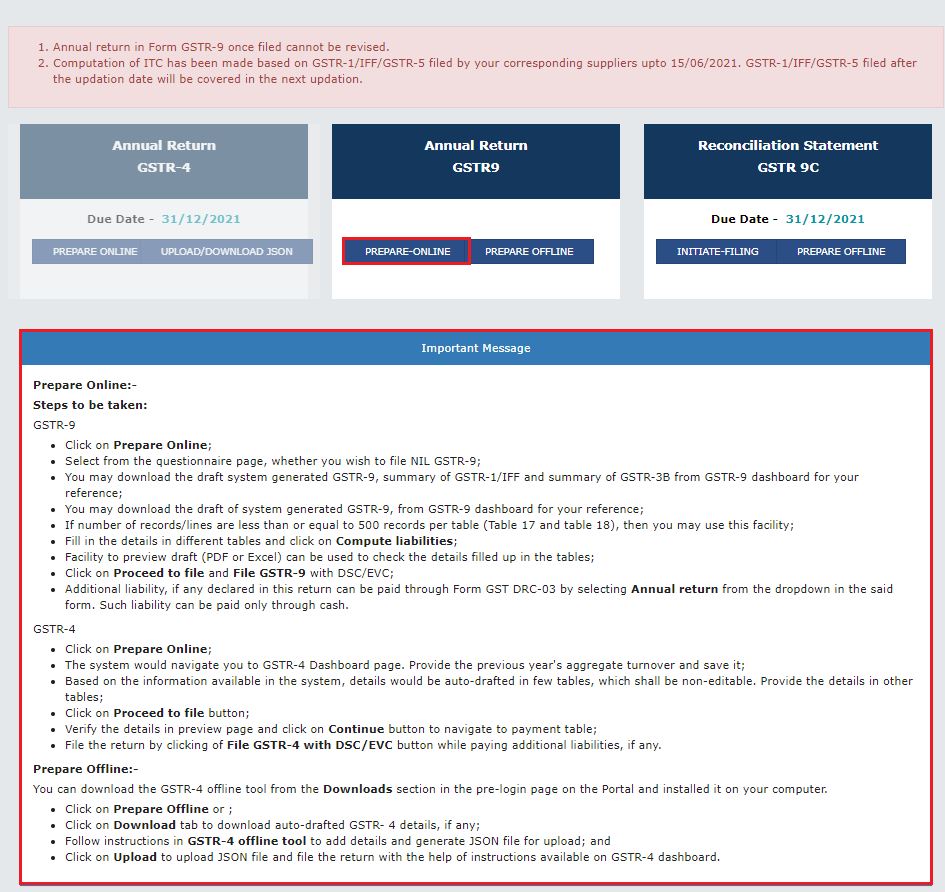
3. Start GSTR-9 Filing: Choose "Prepare Online" or "Prepare Offline." The 'Prepare Online' option is suitable for taxpayers with a smaller volume of data.
4. Check Auto-Populated Data: The system will fill in many fields based on your filed GSTR-1 and GSTR-3B returns. Carefully check this data against your records.
5. Enter Missing Details: Manually enter any additional required information in the various tables of GSTR-9, such as:
6. Calculate Taxes Due: The portal will calculate any additional tax liability.
7. Make Payment (if any): Pay any outstanding taxes or late filing fees.
8. Preview and Check: Download the draft GSTR-9 and carefully look over all the details for errors before final submission.
9. Submit the Return: Once satisfied, send the return using a Digital Signature Certificate (DSC) or Electronic Verification Code (EVC).
10. File GSTR-9C (if it applies): If your annual turnover exceeds Rs. 5 crore, file GSTR-9C after submitting GSTR-9.
Note: You must file GSTR-1 and GSTR-3B for the entire financial year before submitting GSTR-9.
There are no official fees charged by the government for filing GSTR-9 on the GST portal. Filing your annual return is free if done directly online. However, significant penalties apply for late filing or non-filing of GSTR-9. These penalties are significant and are applied to ensure on-time compliance.
If you choose to hire a GST professional or use paid software for filing, the costs generally range as follows:
These fees vary based on the service quality and volume of filings handled.
The GSTR 9 filing due date is usually December 31st of the year after the relevant financial year. For example, for the financial year 2024-25, the GSTR-9 due date would be December 31, 2025. Following this GSTR 9 filing date is important to avoid penalties.
Penalty for late filing of GSTR 9 / GSTR 9 late filing fees:
Filing GSTR-9 on time helps avoid these fees and keeps your GST compliance in good standing, making future audits and assessments smoother.
The format of the GSTR-9 return is divided into several parts, each requiring specific information as per the GST rules. Generally, it covers:
The GSTR 9 annual return is a detailed document. Understanding each section is key to accurate filing. A checklist for filing GSTR 9 can be very helpful to make sure all needed details are covered and prevent common mistakes.
Connect with Startupease and let our experts handle
the legal hassle while you grow your business.