Read More
India has emerged as one of the most promising destinations to invest in startups, driven by rapid digital growth and a large, young population. As per the Ministry of Commerce &...
Register your OPC online with RegisterKaro from ₹1,999. Get your Certificate of Incorporation, PAN, TAN, and DIN through a single, streamlined process in 10–15 business days.
 100% Online Registration with Digital DocumentationCustomized MOA & AOA Prepared for Your BusinessCompany Name Approval & Documentation IncludedCA-Led Filing with Dedicated Expert SupportNo Minimum Capital Requirement for Incorporation
A One Person Company (OPC) is a business structure incorporated by a sole founder under Section 2(62) of the Companies Act, 2013. Introduced in April 2014, an OPC allows a solo founder to operate as a separate legal entity, offering advantages like complete ownership control, easier decision-making, and improved access to financial opportunities.
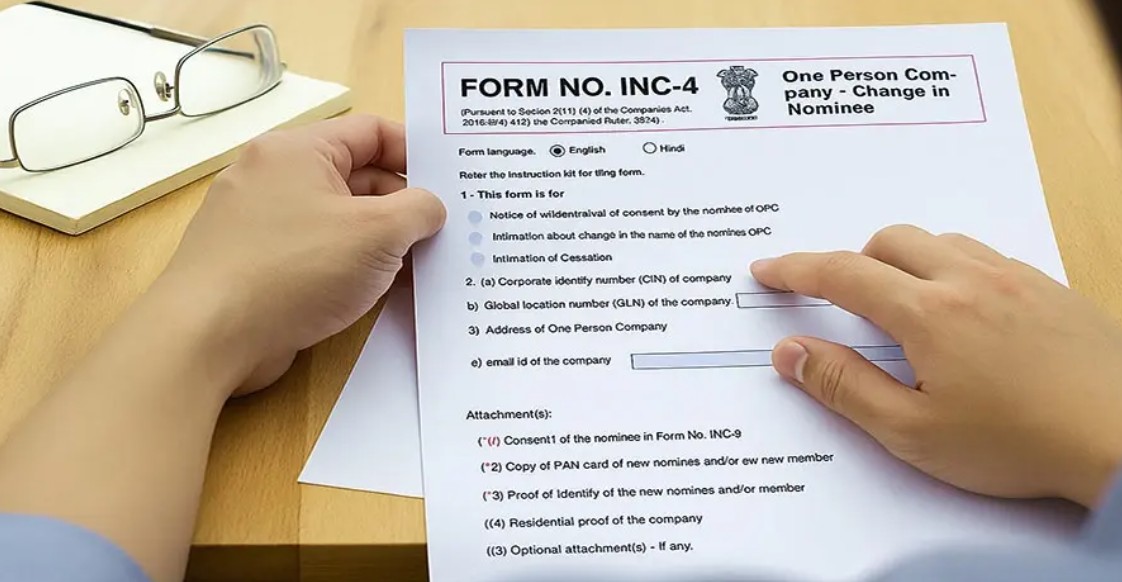
A defining feature of an OPC is the requirement of a nominee, who steps in as the sole founder if the original owner dies or becomes incapable of managing operations. This structure is ideal for freelancers, consultants, and solo founders who want corporate protection without the complexity of additional partners, multiple board meetings, etc.
Note: All SPICe+ filings, including OPC registration, are processed centrally by the Central Registration Centre (CRC) under MCA notification G.S.R. 99(E).
The Companies Act, 2013, permits 5 types of OPC structures based on liability and capital. They are:
| Structure | Liability | When it's used |
|---|---|---|
| OPC Limited by Shares | Limited to the unpaid share value | Default form used in the overwhelming majority of OPC registrations |
| OPC Limited by Guarantee with Share Capital | Unpaid share value + guarantee | Rare; used where flexible capital + guarantee is needed |
| OPC Limited by Guarantee without Share Capital | Guaranteed amount only | Rare; permitted under Section 2(21) |
| Unlimited OPC with Share Capital | Unlimited personal liability | Rarely chosen; defeats the purpose of incorporation |
| Unlimited OPC without Share Capital | Unlimited personal liability | Theoretical only |
In practice, almost every OPC registration in India is filed as a Company Limited by Shares. The other forms are legally available but rarely used.
With online OPC registration, founders get multiple benefits, including:
Limited liability protection: Your personal assets are protected from business debts, and liability is limited to the amount you haven't paid for your shares.
Single-owner control: One person holds 100% ownership and decision-making authority, with no co-founder dilution or partner disputes.
Perpetual succession: The nominee automatically becomes a member on the death or incapacity of the OPC founder so that the company continues without dissolution.
Lower compliance burden: OPCs are exempt from the AGM requirement, mandatory cash-flow statement, and many board-meeting formalities that apply to private limited company registration.
Reduced penalties under Section 446B: Penalties applied in case of non-compliance are much lower for OPCs and small companies (₹5,000 plus ₹500/day for continuing default).
Easier credit and corporate-grade trust: Banks, vendors, and enterprise clients onboard registered companies far more readily than non-registered entities like sole proprietorships.
Tax structuring: An OPC is taxed at corporate tax rates and can claim deductions for eligible business expenses, such as director remuneration, depreciation, rent, and other operating costs. These tax benefits of an OPC can reduce the overall liability compared to paying personal income tax rates on higher business profits.
Easy future conversion: You can voluntarily convert an OPC into a Private Limited Company at any time through Form INC-6. Earlier, mandatory conversion applied if paid-up capital exceeded ₹50 lakh or average annual turnover exceeded ₹2 crore. The Companies (Incorporation) Second Amendment Rules, 2021 (effective 1 April 2021), removed these limits, allowing founders to convert only when business expansion requires it.
For a detailed walkthrough, read our guide on the advantages and disadvantages of OPC in India.
To register a One Person Company (OPC) in India, the applicant must fulfil the eligibility conditions under the Companies Act, 2013:
Single Indian Citizen: Only one natural person who is an Indian citizen can incorporate an OPC. The individual must have stayed in India for at least 120 days during the immediately preceding financial year.
Age Requirement: The applicant must be at least 18 years old. Minors cannot become members or nominees of an OPC.
Nominee Appointment: The sole member must appoint a nominee who will take over membership in case of death or incapacity. The nominee must meet the basic eligibility requirements applicable to OPC members.
One OPC Limit: An individual cannot incorporate more than one OPC or act as a nominee in more than one OPC at the same time.
Restricted Activities: An OPC cannot carry out non-banking financial investment activities, including investing in securities of other companies.
Registered Office in India: The OPC must maintain a registered office address in India for official communication.
No Minimum Capital: There is no minimum paid-up capital requirement, so an OPC can be started with any amount.
Note: Foreign nationals cannot incorporate an OPC in India. However, an NRI who is an Indian citizen may incorporate an OPC if they meet the prescribed residency conditions.
Below is the full checklist of documents required for an OPC registration:
| Category | Documents required |
| Member / Director |
PAN card and Aadhaar card
Government-issued ID (Passport / Driving Licence / Voter ID)
Recent passport-size photographs
Address proof like utility bill or bank statement (not older than 2 months)
| Nominee |
PAN card and Aadhaar card
Recent photograph
Address proof
Signed Form INC-3 (Consent to act as nominee)
| **NRI Member / Director ** |
Passport (mandatory photo ID)
Foreign address proof
Any overseas-executed documents notarized or apostilled (apostille for Hague Convention countries; Indian Embassy/Consulate attestation for non-Hague countries)
| Registered Office |
Ownership proof or rental agreement
No-objection certificate (NOC) from the owner if rented
Recent utility bill (not older than 2 months) showing the address
| Statutory (filed with SPICe+) |
Memorandum of Association (MOA)
Articles of Association (AOA)
Form INC-9 (declaration by first director and subscriber)
DIR-2 (consent to act as director)
Declaration of intended business activities
The One Person Company registration online process is filed through the MCA's SPICe+ form (Part A and Part B). Here is exactly what happens, day by day:
Apply for a Class 3 Digital Signature Certificate for the proposed director to sign the incorporation forms electronically.
Submit up to two preferred names through SPICe+ Part A. The name must end with the suffix "(OPC) Private Limited."
Before filing, verify the name using our free OPC company name check tool to reduce the chances of rejection.
Draft the required incorporation documents, including:
Memorandum of Association (MOA)
Articles of Association (AOA)
Form INC-3 (nominee consent)
Form INC-9 (director declaration)
Also prepare SPICe+ Part B, AGILE-PRO-S, and the integrated PAN and TAN applications.
Submit the complete SPICe+ form through the MCA portal, which is processed by the Central Registration Centre (CRC).
If the proposed director does not already have a DIN, it is allotted through the SPICe+ application, so you do not need to file Form DIR-3 separately.
Along with the SPICe+ incorporation form, you can also file Form AGILE-PRO-S (INC-35) to:
Apply for** GST registration (optional)** if your business requires a GSTIN.
Open a** company current bank account** with the selected bank.
Obtain Professional Tax registration, where applicable, in Maharashtra, Karnataka, and West Bengal.
Complete EPFO and ESIC employer registrations, where applicable.
Note: GST registration becomes compulsory if your aggregate turnover exceeds ₹40 lakh for goods or ₹20 lakh for services (₹20 lakh and ₹10 lakh in special category states). GST registration is also required for an OPC if you engage in activities such as interstate taxable supplies, e-commerce, or other notified transactions.
The CRC reviews the application and may issue resubmission queries. If the CRC raises any such queries, submit the corrected documents or information promptly to avoid delays in incorporation.
On approval, the MCA issues the Certificate of Incorporation with a unique Corporate Identity Number (CIN), formatted as state code + year + entity type + ROC code + sequence. The company's PAN and TAN are issued together with the COI.
What you receive on Day 15: Certificate of Incorporation, CIN, PAN, TAN, DIN, DSC, MOA & AOA, and Director KYC pack.
**Note: **After incorporation, an OPC with share capital must file Form INC-20A within 180 days before commencing business or borrowing funds.
From DSC to COI, One Person Company Registration online takes 10–15 business days. Stage-wise breakdown:
| Stage | Estimated time |
| Class 3 DSC | Within 1 day |
| Name approval (SPICe+ Part A) | 1–3 business days |
| Document preparation (MOA, AOA, INC-3, INC-9) | 2–4 business days |
| Filing SPICe+ Part B with the CRC | 1 business day |
| CRC verification and MCA approval | 5–7 business days |
| Issue of Certificate of Incorporation, PAN & TAN | 1–2 business days |
| Total | 10–15 business days |
Note: The timeline assumes accurate documents and no MCA resubmission queries. It may take longer to register an OPC if the proposed name is rejected, DSC verification is delayed, or the MCA requests corrections.
The total OPC registration cost depends on three components:
Government filing fees,
State-wise stamp duty, and
Professional fees.
Here’s a detailed breakdown of the total cost of OPC registration in India:
| Fee component | Approximate amount | Notes |
| Government filing fees | ₹0 up to ₹15 lakh authorized capital; from ₹1,000+ above that | OPC registration government fees are waived under the MCA's zero-fee scheme |
| DSC (Class 3) | ₹2,500 per DSC | One token for the proposed director |
| DIN allotment | Included in SPICe+ | Allotted free through SPICe+ at no additional cost |
| PAN and TAN | ₹131 | Issued along with the COI |
| State-wise stamp duty (MOA + AOA) | ₹100 – ₹15,000+ | Varies sharply by state of incorporation and authorized capital |
| Professional / consultancy fees | ₹1,999 | Drafting, filing, MCA query handling, and post-incorporation kit |
| Typical total (cap up to ₹15 lakh) | ₹5,000 – ₹17,500 | Bundled fixed pricing available with StartupEase |
**Note: **For NRI applicants, notarization, apostille, or consular attestation of overseas documents is an additional out-of-pocket expense and is not included in the professional fee.
After receiving the Certificate of Incorporation (COI), you must complete a few operational and compliance formalities:
Issue the share certificate to the sole shareholder within 60 days of incorporation.
Deposit the subscribed share capital into the company's current bank account and record the transaction in the books of accounts.
Apply for any additional business licences, such as FSSAI, IEC, Trade Licence, or state-specific registrations, if your business activity requires them.
Maintain statutory registers and books of accounts from the first day of business operations.
Although an OPC offers the benefits of a company, the Companies Act, 2013, imposes certain restrictions on its incorporation and operations:
Non-banking financial activities, including investment in the securities of any body corporate, are not permitted.
Minors and persons disqualified under Section 164 of the Companies Act, 2013, are ineligible to incorporate or manage an OPC.
An individual may incorporate or act as a nominee in only one OPC at any given time.
Conversion into a Section 8 (non-profit) company is not permitted.
A nominee must be appointed at the time of incorporation, and any subsequent change must be reported to the MCA within the prescribed timeline.
Note: These restrictions are prescribed under the Companies Act, 2013, and cannot be modified through the MOA and AOA. If your business involves NBFC activities, charitable objectives, or multiple founders, consider registering a Private Limited Company, LLP, or Section 8 Company, as appropriate.
Once incorporated, an OPC must maintain ongoing ROC and tax compliance. The mandatory annual compliance requirements of an OPC are:
| Form | What it covers | Due date | Penalty |
| AOC-4 | Audited financial statements | Within 180 days of FY end (typically 27 Sep, 2026) | ₹100/day |
| MGT-7A | Abridged annual return for OPCs/small companies | Within 60 days of signing AOC-4 (typically 28 Nov, 2026) | ₹100/day |
| ADT-1 | Auditor appointment for 5 years | Within 15 days of auditor’s appointment of the OPC | Filing fee + late fee |
| DIR-3 KYC | Director KYC | Triennial filing from FY 2026–27 (next due year depends on the last KYC filing) | ₹5,000 + DIN deactivation |
| DPT-3 | Return of deposits / exempted deposits | By 31 July 2026 (extended from 30 June 2026 through General Circular 02/2026) | ₹100/day |
| ITR-6 | Income tax return | By 31 October 2026 (subject to audit applicability) | Up to ₹10,000 + interest |
| GST returns | If turnover exceeds the threshold | Monthly / quarterly as applicable | ₹50/day + interest |
Late filing of AOC-4 or MGT-7A attracts ₹100 per form per day with no upper cap. StartupEase's annual compliance plan covers all five ROC filings (AOC-4, MGT-7A, ADT-1, DIR-3 KYC, DPT-3) and your ITR-6 for a fixed annual fee. GST return filing is added on if your turnover crosses the registration threshold.
After the CRC approves your application, the MCA emails the COI and also makes it available for download on the MCA portal. The COI contains the company name, CIN, incorporation date, and registered office address.
To download the OPC registration certificate:
Visit mca.gov.in and log in.
Go to MCA Services → View Public Documents (or Get Certified Copies).
Search by company name or CIN.
Pay the certified-copy fee if applicable and download the PDF.
Follow these steps to track the progress of your OPC application online:
On the MCA portal, go to MCA Services → Track SRN / Transaction Status.
Enter your Service Request Number (SRN) issued at filing.
View real-time status: Pending, Under Resubmission, Approved, or Rejected.
Note: If the MCA marks your application for Resubmission, you must respond within 15 days, failing which the application may lapse.
If you're a solo founder choosing between structures, the differences below drive the decision.
| Parameter | OPC | Sole Proprietorship | Private Limited Company |
| Legal Status | Separate legal entity | No separate legal identity from the owner | Separate legal entity |
| Owners Required | 1 member + 1 nominee | 1 proprietor | Minimum 2 shareholders + 2 directors |
| Liability | Limited to unpaid share value | Unlimited personal liability | Limited to unpaid share value |
| Compliance Burden | Moderate compliance (ROC filings + ITR; no AGM) | Lowest compliance (mainly tax filings) | Higher compliance (ROC filings, AGM, statutory records, ITR) |
| Taxation | Corporate tax rate of 22% under Section 115BAA + surcharge and cess | Taxed as individual income as per applicable slabs | Corporate tax rate of 22% under Section 115BAA + surcharge and cess |
| Owner Remuneration | Director salary allowed as business expense | Not applicable | Director salary allowed as business expense |
| External Funding | Limited funding options; cannot issue equity to investors | Difficult to raise external funds | Suitable for angel funding, VC investment, and equity fundraising |
| Conversion to Private Limited Company | Voluntary conversion allowed by filing Form INC-6 | Requires fresh incorporation | Already operates as a private company |
| Audit Requirement | Mandatory statutory audit every year | Required only if tax audit limits apply | Mandatory statutory audit every year |
| Nominee Requirement | Mandatory nominee appointment | Not required | Not required |
| Best Suited For | Solo founders seeking corporate status and limited liability | Small businesses, freelancers, and low-compliance setups | Startups and businesses planning growth, investment, and expansion |
Connect with Startupease and let our experts handle
the legal hassle while you grow your business.