Read More
India has emerged as one of the most promising destinations to invest in startups, driven by rapid digital growth and a large, young population. As per the Ministry of Commerce &...
Get your professional tax registration done right. We simplify state compliance for businesses and professionals so you can focus on what matters most.

Professional tax registration is the process where employers and businesses register with their state's Commercial Tax Department for collecting and paying professional tax. It’s a state-level levy regulated by the State Professional Tax Acts, allowing governments to tax professions, trades, and employment.
According to Hindustan Times, Professional tax collections have increased by 27% in major Indian states over the last two years, with enforcement becoming significantly stricter. This trend demonstrates the growing importance of timely professional tax registration for businesses and professionals across India.
Professional tax registration applies to various entities and situations. The two main certificates are PTEC and PTRC, but registration is also required in the following scenarios:
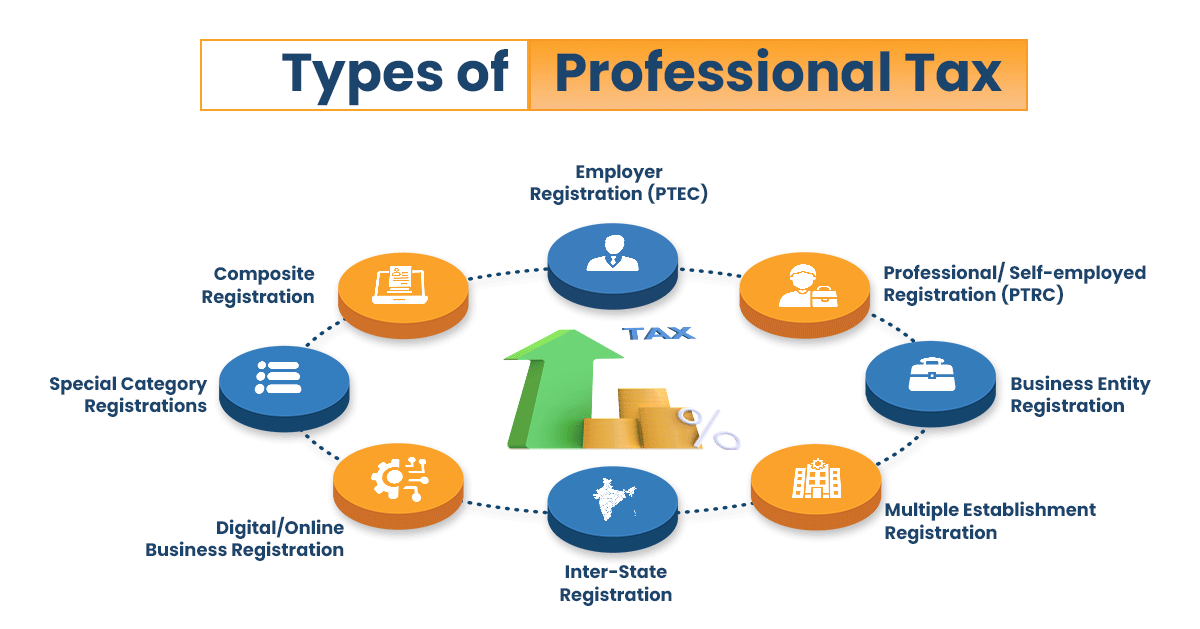
Employers must obtain PTRC registration to deduct professional tax from employee salaries and remit it to the state. For instance, a software company with 50 employees in Karnataka needs this registration to deduct professional tax from its employees' salaries.
This is mandatory for self-employed professionals, consultants, and individuals engaged in any trade or profession, for their professional tax liability. For example, a chartered accountant in Maharashtra must obtain PTEC registration for their professional tax compliance.
Partnerships, LLPs, and other business entities must register for requirements based on their structure and state laws.
For example: a retail partnership in Tamil Nadu must register for professional tax according to its annual turnover.
a. Multiple Establishment Registration
Businesses with multiple locations in the same state must register each establishment separately.
For instance: a restaurant chain with 5 outlets in West Bengal needs individual professional tax registrations for each location.
b. Inter-State Professional Tax Registration
Businesses operating in multiple states must register in each one.
Example: A consulting firm serving Gujarat and Maharashtra needs separate registrations in both states.
c. Digital Platforms and Online Businesses Registration
Digital businesses and online service providers must meet state-specific registration requirements.
For instance: an e-commerce business in Telangana must register for professional tax, regardless of whether it has a physical retail location.
d. Special Category Registrations
Certain professions, such as doctors, lawyers, and architects, require specialized registration.
For example: lawyers in Kerala must register under a specific category for legal professionals.
e. Composite Registration
Combined registration options for professionals with multiple business structures in certain states.
For example: a doctor in Odisha with a private practice and a consultancy may qualify for combined registration.
Professional tax registration is governed by state-specific regulations that outline the procedure for professional tax registration, eligibility, and compliance requirements.
1. Article 276 of the Constitution of India - Empowers states to levy taxes on professions, trades, callings, and employments, with a maximum professional tax limit of Rs. 2,500 per person annually.
2. State-specific Professional Tax Acts - Each state has its legislation (e.g., Maharashtra State Tax on Professions, Trades, Callings and Employments Act, 1975; Karnataka Tax on Professions, Trades, Callings and Employments Act, 1976).
3. Professional Tax Rules - Procedural regulations detailing registration, payment schedules, returns filing, and penalties in each state.
4. State Finance Acts - Annual modifications to professional tax slabs, exemptions, and procedural requirements for professional tax registration.
5. Municipal Corporation Acts - In some states, municipal bodies are authorized to collect professional tax within their jurisdiction.
Professional tax registration has distinct characteristics that shape how these compliance frameworks function:
When establishing professional tax registration in India, professional assistance provides significant advantages:
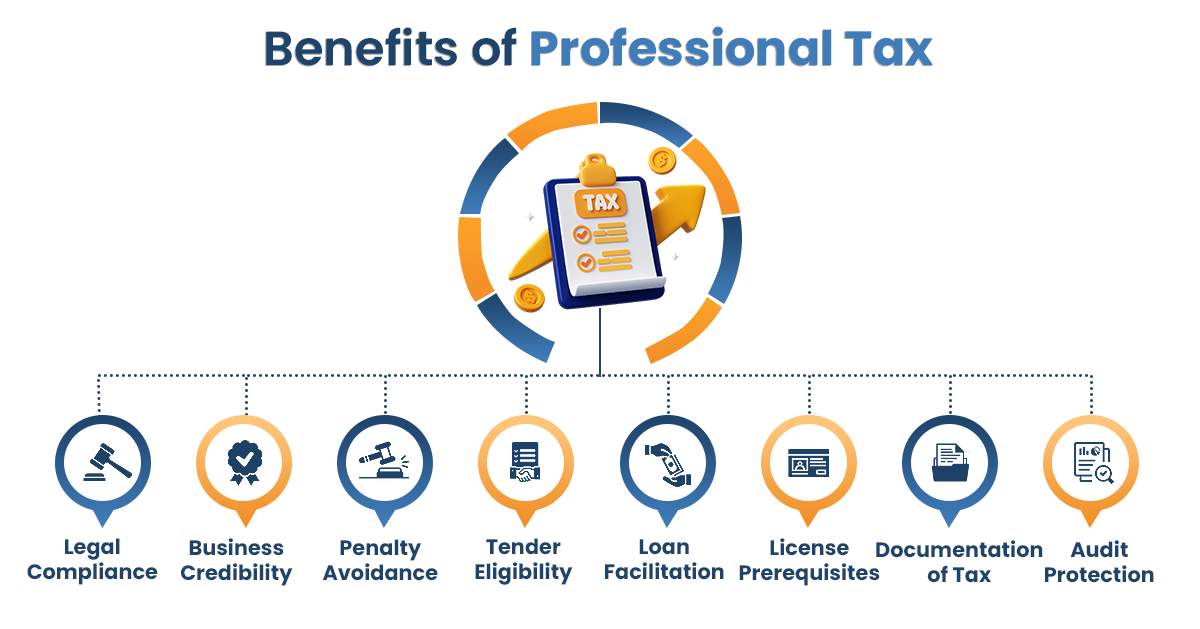
Professional tax registration ensures businesses follow state tax laws.
Compliance enhances a business’s trustworthiness and professional image.
Timely registration and filing help avoid financial and legal penalties.
Essential for qualifying to bid on government contracts and tenders.
Tax compliance supports credibility during loan evaluation processes.
Having proper tax records ensures readiness for audits and inspections.
Professional tax is applicable in various states across India in the following manner:
This means the highest monthly deduction would typically be Rs. 200 - Rs. 208 for 11 months, with sometimes a slightly higher amount in one specific month (e.g., February in Maharashtra) to reach the annual cap of Rs. 2,500.
Many states also provide exemptions for certain categories of individuals, such as very low-income earners, persons with disabilities, senior citizens (above a certain age, which varies by state), or specific military personnel.
Here's a general overview of how amounts typically range, keeping the Rs. 2,500 annual cap in mind:
Examples from Key States (illustrative, for current FY 2024-25, subject to change):
Professional tax registration is required for individuals and entities engaging in specific professional or business activities as per state regulations.
1. Income Threshold - Individuals earning above the state-specified minimum income level (varies by state, typically ranging from Rs 5,000 to Rs 10,000 monthly).
2. Professional Status - Individuals practicing professions such as medicine, law, accounting, engineering, architecture, and consultancy services.
3. Business Operation - All businesses, including sole proprietorships, partnerships, LLPs, and companies operating within a professional tax-levying state.
4. Employer Status - Any entity employing individuals and liable to deduct professional tax from employee salaries.
5. State Presence - Physical location or business operations within the jurisdiction of a state that imposes professional tax.
6. Trade Engagement - Individuals or entities engaged in specified trades or commercial activities as defined in the state's professional tax schedule.
7. Service Provision - Providers of professional services, including coaching, training, technical services, and specialized consultations.
Meeting these statutory and operational requirements necessitates registration under the respective state's professional tax regime to maintain compliance and avoid penalties.
An effective professional tax registration requires proper documentation to establish business legitimacy and professional status:
Establishing effective professional tax registration requires careful planning and execution:
Assess whether your business or profession falls under the professional tax purview in your state and identify the applicable registration category.
Gather all required documents, including business registration certificates, identity proofs, address verification, and other state-specific requirements.
Fill the appropriate professional tax registration form (typically Form I for employers/PTEC and Form II for professionals/PTRC) with accurate business or professional details.
While professional tax is a state-level tax, leading to variations across India, it's less about one state having a unique process and more about differences in specific details, forms, online portals, and compliance nuances.
For instance, states like:
Maharashtra Professional Tax: Maharashtra has well-established online systems and explicitly uses Form I for PTRC and Form II for PTEC, which, while a common structure, isn't universally adopted across all professional tax-levying states.
Karnataka Professional Tax: The professional tax registration process is primarily handled through the e-PRERANA portal (Profession Tax Enrolment Registration And Administration), managed by the Commercial Taxes Department, Government of Karnataka.
West Bengal Professional Tax: In West Bengal, professional tax is regulated by the West Bengal State Tax on Professions, Trades, Callings and Employment Act, 1979, with the primary online portal being professiontax.wb.gov.in. Employers typically file Form III as their return and remit the collected tax by the 15th day of the following month, though smaller payers might have an annual return option by April 30th, following the end of their accounting year.
Tamil Nadu Professional Tax: In Tamil Nadu, professional tax is levied by local bodies such as Municipalities and Corporations, rather than a single state-wide authority, under the Tamil Nadu Municipal Laws. Consequently, the registration and payment processes are often handled through the specific municipal corporation's online portal.
Therefore, it's crucial for individuals and businesses to always consult the official website of the Commercial Tax Department (or equivalent authority) of the relevant state for accurate and current registration procedures and forms.
Submit the applicable professional tax registration fees as prescribed by the state government, which may vary based on business category and state, such as Rs. 2,500 annually in Maharashtra for certain businesses.
File the completed application along with supporting documents either online or physically at the designated office.
Undergo any verification procedures required by the tax authorities, which may include document scrutiny or physical premises verification in some states.
PTEC (Professional Tax Enrollment Certificate) is for professionals (self-employed individuals) and entities paying their professional tax.
PTRC (Professional Tax Registration Certificate) is for employers who deduct professional tax from their employees' salaries and remit it to the state government.
Prominently display the registration certificate at your business premises as required by most state professional tax laws.
Maintain ongoing compliance by timely tax deduction, payment, and returns filing as per the state-specific schedule.
Complete your professional tax registration in no time. Startupease ensures you meet all the professional tax registration requirements and deadlines, avoiding any potential issues. Leave the paperwork to us. Get in touch with our experts today!
Understanding the financial aspects and potential penalties associated with professional tax registration is essential for professionals and businesses:
The registration costs for professional tax registration vary depending on the application, as follows:
Payment structure for a professional tax registration depends on the person seeking it, as follows:
Delays in registration can lead to different types of fines and penalties, as follows:
Ensure your professional tax registration compliance with Startupease! Get expert guidance and avoid penalties by completing your registration seamlessly today.
Professional Tax compliance in India is a mandatory requirement for individuals and entities earning income from a profession, trade, or employment, depending on the specific state laws.
Here are the key aspects of Professional Tax compliance:
A Professional Tax Registration Certificate is the official document issued by the state's professional tax department upon successful completion of the registration process. This certificate serves as undeniable proof that an individual or entity is legally authorized to operate under the state's professional tax regulations.
Possessing this certificate is not just a formality; it's a legal requirement that enables you to fulfill your professional tax obligations correctly and without impediment. The registration number on the certificate acts as your primary identifier when remitting tax or filing returns with the government authorities.
Connect with Startupease and let our experts handle
the legal hassle while you grow your business.