Read More
India has emerged as one of the most promising destinations to invest in startups, driven by rapid digital growth and a large, young population. As per the Ministry of Commerce &...
egally remove a director from your company with Startupease. Our experts ensure every step complies with the Companies Act, 2013, enabling smooth, compliant leadership transitions effortlessly.
 Complete Legal DraftingROC Filing SupportExpert ConsultationEnd-to-End Process ManagementTrusted by 20,000+ Brands
Running a company is like steering a ship, with directors acting as the captains responsible for its direction and operations. Directors are responsible for making critical strategic decisions. But what if a captain isn't doing a good job? Or what if they want to leave? This is when you need to know about the removal of a director.
A director, as defined under Section 2(34) of the Companies Act, 2013, is a leader appointed by the shareholders, who are the company's owners.
A director's main job is to manage the company. Together, they form the Board of Directors, the team responsible for guiding the company in the right direction. The Companies Act, 2013, serves as the rulebook, outlining who directors are and their responsibilities.
A director has many important jobs. Directors must act in good faith and the best interests of the company, as outlined in Section 166 of the Companies Act, 2013. Their role is to steer the company in the right direction while ensuring its success. Here are some of their key tasks:
The Companies Act, 2013, governs the removal of a director, with Section 169 giving shareholders the power to remove a director through an ordinary resolution. Other important sections include:
Section 169 gives shareholders a lot of power. But there are some limits. A director cannot be removed by shareholders in these cases:
A director can be removed for various reasons, ranging from poor performance and misconduct to conflicts of interest.
There are three main ways a director can be removed from their position.
For the removal process to be valid, some conditions must be met. These are like essential rules that cannot be ignored.
Having the right documents is very important. It ensures the process is smooth and legal. Here is a simple checklist:
Now, let's look at the step-by-step process for different removal methods.
A director may decide to resign for personal or professional reasons. This is a voluntary process.
A director must attend board meetings, and if they miss all meetings for a continuous period of 12 months, their office becomes vacant. This is not a direct removal but a vacation of office under Section 167(1)(b) of the Companies Act.
This is a very important power given to shareholders. It ensures that they have control over who manages their company. The process is detailed in Section 169 of the Companies Act.
A nominee director is appointed by a bank, financial institution, or another third party. They are appointed to protect the interests of the entity that nominated them.
The removal of a nominee director is simple. The entity that appointed them can remove them at any time as per the terms of the agreement and subject to AoA. They just need to inform the company in writing. The company's shareholders do not have the power to remove a nominee director.
The National Company Law Tribunal (NCLT) can remove a director. This is a serious step taken in extreme cases under Section 242(2)(h).
The NCLT can remove a director if a complaint is filed against them for:
If the NCLT finds the director guilty, it can order their removal. A director removed by the NCLT cannot be appointed as a director in any company for five years.
The fees for removing a director are paid to the Registrar of Companies (ROC) for filing the required forms, mainly Form DIR-12. The government fee depends on the company's authorized share capital, as follows:
| Authorized Share Capital | Government Fee for Form DIR-12 |
| Up to Rs. 1,00,000 | Rs. 200 |
| Rs. 1,00,001 to Rs. 5,00,000 | Rs. 300 |
| Rs. 5,00,001 to Rs. 25,00,000 | Rs. 400 |
| Rs. 25,00,001 to Rs. 1,00,00,000 | Rs. 500 |
| Above Rs. 1,00,00,000 | Rs. 600 |
Professional Fees: In addition to government fees, you can expect charges for the professional services involved in the removal process. These typically include:
These fees vary based on the complexity of the process and the services required.
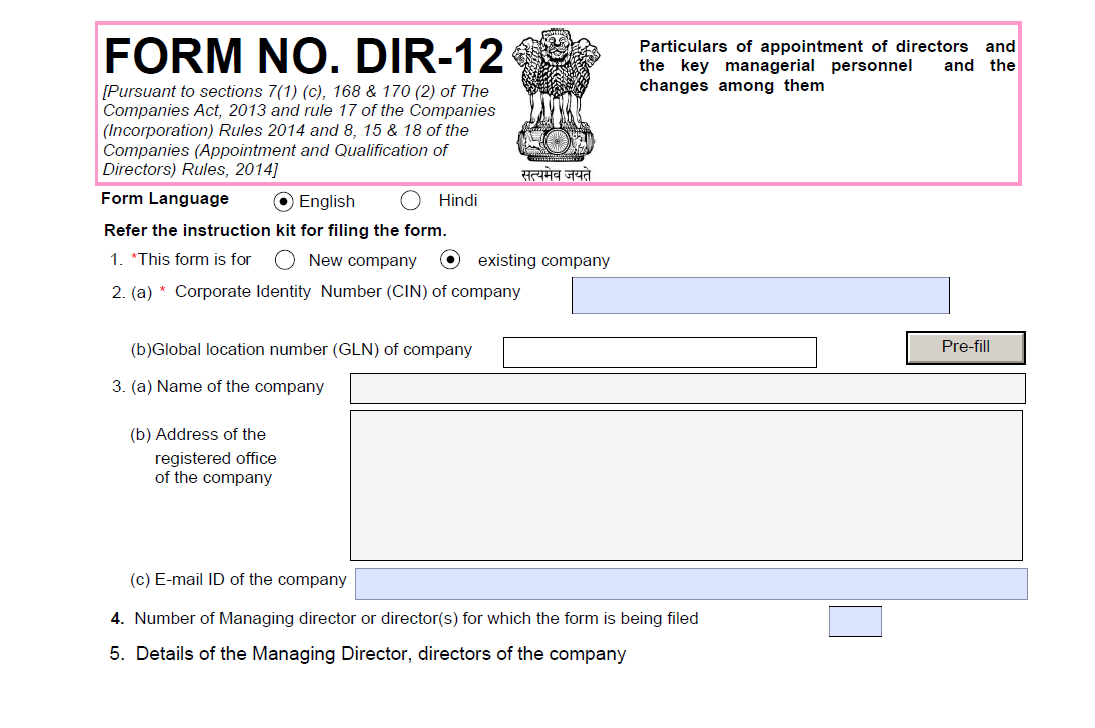
Form DIR-12 is a very important e-form. It is used to notify the ROC about any changes in the Board of Directors.
This form must be filed whenever a director is:
The company must file Form DIR-12 within 30 days of the resignation/removal/appointment of a director. The form needs to be digitally signed by a continuing director or a key managerial person of the company.
Not filing Form DIR-12 on time can lead to serious problems for the company.
As per the latest MCA guidelines:
This means the penalty now accrues daily after the initial 30-day window, making delays significantly more expensive over time. For example, a 208-day delay recently led to a total penalty of ₹4.54 lakh for a company and its directors.
The removal of a director has consequences for both the director and the company.
Connect with Startupease and let our experts handle
the legal hassle while you grow your business.