
Read More
India has emerged as one of the most promising destinations to invest in startups, driven by rapid digital growth and a large, young population. As per the Ministry of Commerce &...
Register your business for GST with expert legal support for tax benefits, expansion across India, and compliance with government regulations.
 Claim Input Tax Credit (ITC)Quick GSTIN Approval with Complete DocumentationGST Registration CertificateLegal Guidance from GST ExpertsTrusted by 20,000+ Businesses
GST (Goods and Services Tax) Registration is a mandatory process for businesses engaged in the supply of goods or services crossing specific turnover thresholds. It applies to:
GST was launched with the main objective of combining various central and state taxes into one single tax on the supply of goods and services. Before GST, businesses had to deal with multiple taxes like VAT, excise duty, and service tax, making the system complicated.
GST registration is the process by which a business or individual becomes registered under the Goods and Services Tax system. This process grants the entity a unique GSTIN (Goods and Services Tax Identification Number), which is required to conduct any taxable activity. It serves as proof that the entity is authorized to collect GST on behalf of the government.
In India, GST registration is essential for businesses to operate legally. It allows them to collect tax, avail input tax credit, expand business, and comply with regulations.
GST works on a value-added system, where tax is charged at each step of the supply chain—from manufacturer to retailer.
GST registration in India varies based on the nature of the business and its turnover.
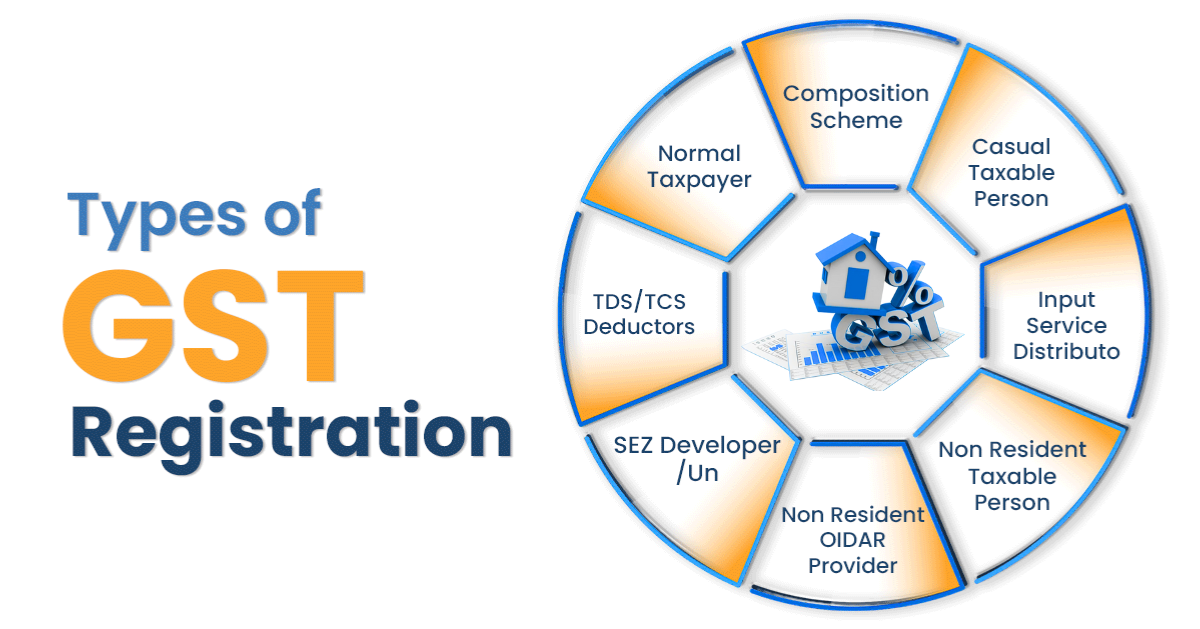
GST follows a dual structure because India is a federal country. This system allows both the Central and State governments to levy and collect taxes on transactions, ensuring a clear division of revenue.
This structure comprises four main components:
CGST and SGST are typically levied concurrently on the same transaction:
GST registration is a mandatory requirement for businesses and individuals once their annual aggregate turnover crosses specific thresholds within a financial year.
It is important to note that the GST Council increased the minimum turnover threshold for goods suppliers from ₹20 lakh to ₹40 lakh, aiming to provide relief to small businesses.
Special Category States: For certain designated states, the turnover thresholds are lower to account for their unique economic conditions. These states include:
In short, the GST Registration thresholds vary based on states as follows:
| Type of Supply | Normal Category States Threshold (₹) | Special Category States Threshold (₹) |
| Goods | 40 Lakhs | 20 Lakhs |
| Services | 20 Lakhs | 10 Lakhs |
| Both Goods & Services | 20 Lakhs (for services component) | 10 Lakhs (for services component) |
Here are some advantages of registering for GST:
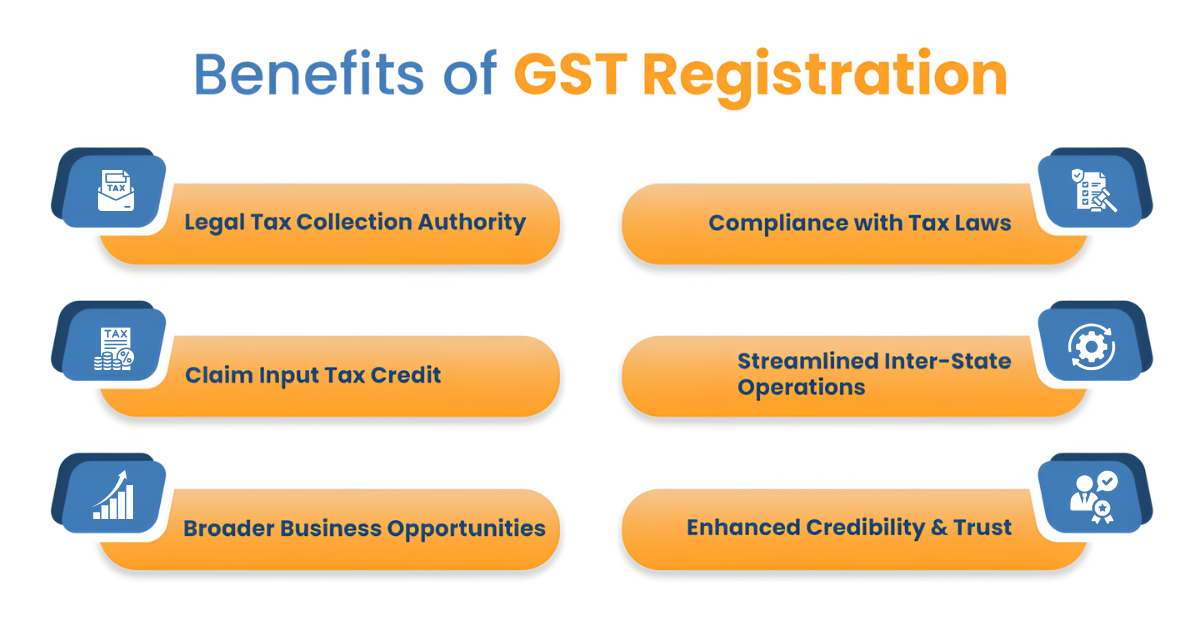
Certified Collection Rights: Registered businesses can legally collect GST from customers, promoting transparency and aiding government taxation. This legal approval ensures taxes are collected as per government rules, reducing the chances of errors or misuse.
Boosts Business Credibility: Issuing GST invoices after registration builds trust with clients and vendors, enhancing your company’s market image and GSTIN authenticity. This added credibility reassures stakeholders about the legitimacy and reliability of your business operations.
Reduced Tax Burden: Claiming credit on GST paid after GST Registration lowers your overall tax liability and improves cash flow efficiency.
Encourages Accurate Accounting: Promotes proper record-keeping for GST compliance and penalties, and ensures smoother audits and vendor interactions.
Simplifies Compliance: Integrates GST credit claims with statutory norms for hassle-free adherence. This alignment simplifies tax computations by matching exact legal requirements.
Eligibility for Contracts: GST Registration benefits also include access to government tenders and B2B contracts, opening new avenues for growth. This eligibility not only enhances credibility but also provides a platform for strategic partnerships.
Improved Market Reach: Enhances customer trust and enables interstate and online business without restrictions after checking your registration status. Expanding your market reach facilitates greater business visibility and opens doors to diverse customer segments.
Avoids Legal Penalties: Being GST-compliant ensures adherence to tax laws, protecting your business from GST compliance and penalties.
Supports Seamless Audits: Regular filings and reports linked to your GSTIN make audits easier and enhance your company's legal standing.
Strengthens Business Reputation: Accurate GST compliance enhances your business's reputation by demonstrating reliable financial practices. It builds stakeholder confidence and bolsters your credibility in the market.
Operate Across States: GST Registration allows smooth interstate operations by eliminating state-wise tax barriers for registered businesses. This unified framework simplifies logistics and ensures the efficient movement of goods across state borders.
Enables Online Selling: Facilitates nationwide e-commerce through platforms like Amazon and Flipkart, provided key documents are submitted correctly. This streamlined process boosts your online sales potential and enhances your brand's visibility across digital marketplaces.
GST registration is mandatory or advisable for a wide range of businesses and individuals involved in the supply of goods or services in India. You are eligible (and in some cases, required) to register under GST if:
Voluntary registration is also allowed for small businesses below the threshold limit, helping them claim Input Tax Credit (ITC) and build credibility
Beyond turnover thresholds, several specific business scenarios mandate GST registration:
Even if a business does not meet the mandatory turnover threshold or fall into any of the specific mandatory categories, it has the option to register for GST voluntarily.
For small business owners, choosing the appropriate GST scheme impacts tax liability, compliance burden, and business operations. The two primary schemes are:
This scheme is mandatory for businesses whose annual aggregate turnover exceeds the prescribed thresholds (₹40 lakh for goods, ₹20 lakh for services in most states, and lower for special category states). Businesses that do not meet these thresholds can also opt for this scheme voluntarily.
The scheme is best suited for medium to large businesses, e-commerce operators, service providers, manufacturers, and B2B businesses. It is particularly advantageous for those involved in interstate trade or those seeking to maximize tax efficiency by leveraging ITC.
Businesses can opt for the Composition Scheme if their annual aggregate turnover is up to ₹1.5 crore in most states. The turnover limit for GST registration in North-Eastern states and Himachal Pradesh is ₹75 lakh.
Businesses under this scheme pay GST at a reduced, fixed rate on their taxable turnover, rather than the standard GST rates.
The Composition Scheme is best for small businesses that mainly sell within their state to regular consumers (B2C) and want simpler tax rules and lower rates.
The following table distinguishes both the GST Schemes clearly:
| Criteria | Regular Scheme | Composition Scheme |
| Turnover Limit | Mandatory for turnover > ₹40L (goods) / ₹20L (services) in most states; no upper limit for voluntary opt-in | Up to ₹1.5 Cr (most states) / ₹75L (special category states) |
| Input Tax Credit (ITC) | Allowed to claim ITC on purchases | Not allowed to claim ITC on purchases |
| Tax Rates | Standard GST rates (5%, 12%, 18%, 28%) | Fixed lower rates (e.g., 1% for traders/manufacturers, 5% for restaurants, 6% for service providers) |
| Compliance Burden | High (multiple monthly/quarterly returns, detailed invoices, reconciliation) | Low (simple quarterly filings, less record-keeping) |
| Invoice Type | Can issue Tax Invoices | Must issue Bill of Supply (cannot charge tax from customers) |
| Inter-State Sales | Allowed without restrictions | Not Allowed (barred from interstate trade) |
| E-commerce Sales | Allowed | Not allowed to supply goods through e-commerce operators |
| Best Fit For | Medium/large businesses, B2B, interstate trade, e-commerce, maximizing tax efficiency | Small businesses, B2C, local trade, preference for simplified compliance |
Regardless of the specific business type, the following documents are mandatory for GST registration:
Note: The required documents can vary based on your business structure (e.g., a Partnership Firm requires a Partnership Deed, while an LLP needs its LLP Agreement). For a personalized checklist tailored to your business, consulting a professional is recommended.
Businesses and individuals can complete the entire procedure through the official GST portal in the following manner:
The first stage of GST registration involves generating a Temporary Reference Number (TRN), which acts as a temporary identifier for your application.
Go to the GST portal, choose "New Registration" > "TRN", and log in using the OTP sent to your registered email and mobile.
Click on "My Saved Application" and use the edit option to continue filling out Form GST REG-01.
Enter your trade name, business type, district, codes, and dates for business start and GST liability. Choose the Composition Scheme if eligible.
Add details of promoters/partners like name, PAN, Aadhaar, contact, and DIN (if applicable).
Provide details and documents for the person handling GST compliance on behalf of your business.
Enter your main business address, upload proof, and mention any additional business locations.
List the goods/services you deal in with their HSN/SAC codes.
Submit your bank account number, IFSC, and upload a cancelled cheque or statement.
Add any additional information required by your state, if applicable.
Choose to verify via Aadhaar for faster processing, or skip and undergo manual verification.
Review all details, tick the declaration, and submit using DSC, e-Sign, or EVC as per your business type. Once you successfully submit your GST registration application, you’ll receive an Application Reference Number (ARN) as confirmation.
This unique 15-digit number is crucial for tracking the status of your application online and will be sent to your registered email address and mobile number.
The time taken for the GST registration process varies based on several factors
Factors Affecting GST Registration Timeline:
The validity of a GST registration certificate varies depending on the type of taxpayer:
The registration fees may vary depending on different scenarios:
So, if a business crosses the GST threshold and fails to register, it can face heavy penalties along with interest on unpaid tax.
For regular taxpayers, GST registration generally has no expiry date, and therefore, no separate renewal process or fees are required. Their GSTIN remains valid indefinitely, provided they regularly meet compliance requirements like timely return filing and tax payment.
This continuous compliance effectively serves as the "renewal" for regular taxpayers.
The following factors need to be considered as well:
GST registration can be cancelled either voluntarily by the taxpayer or initiated by a GST officer due to non-compliance or other valid reasons.
The reasons for cancellation are likewise:
GST officers have the authority to cancel registration if they find non-compliance or fraudulent activities. Common reasons include:
It is crucial to note that GST registrations cannot be cancelled without filing all pending returns. Only then can they apply for cancellation by submitting Form GSTR-10 (Final Return).
Here‘s how GST Registration can be cancelled:
If the cancellation is initiated by the GST officer, a show-cause notice (Form GST REG-17) will be issued first, providing the taxpayer an opportunity to respond and explain why their registration should not be cancelled.
Adhering to GST regulations is crucial for smooth operations and to avoid legal consequences and penalties. GST compliance broadly includes key categories that businesses must diligently follow:
All businesses registered under GST are generally mandated to file various GST returns, with the frequency (monthly, quarterly, or annually) depending on their turnover and the scheme they have opted for.
| Form Name | Applicable For | Frequency | Due Date | Purpose |
| GSTR-1 | All normal registered taxpayers (outward supplies) | Monthly/Quarterly (for QRMP scheme) | 11th of next month (monthly) / 13th of the month following quarter (quarterly) | To report details of outward supplies (sales) made during the tax period. |
| GSTR-2A/2B | Auto-drafted statement of inward supplies (purchases) | Monthly | Dynamic (2A) / 12th of next month (2B) | For viewing and reconciling input tax credit details based on suppliers' GSTR-1 filings. |
| GSTR-3B | All normal registered taxpayers (summary return) | Monthly/Quarterly (for QRMP scheme) | 20th of next month (monthly) / 22nd/24th of month following quarter (quarterly) | A summary return of outward supplies, inward supplies, ITC claimed, and tax liability, along with tax payments. |
| GSTR-4 | Composition scheme taxpayers | Quarterly | 18th of the month following the quarter | Quarterly return for composition dealers to declare their turnover and pay tax. |
| GSTR-9 | All normal registered taxpayers (annual return) | Annually | 31st December of the next financial year | An annual reconciliation of monthly/quarterly returns with audited annual accounts. Mandatory for turnover > ₹2 crore. |
| GSTR-10 | Taxpayers with cancelled GST registration | Once (Final Return) | Within 3 months of the cancellation order | A final return to clear any pending liabilities after GST registration cancellation. |
| GSTR-5 | Non-Resident Taxable Persons | Monthly | 20th of next month | Details of outward and inward supplies made by non-resident taxable persons. |
| GSTR-6 | Input Service Distributors (ISD) | Monthly | 13th of next month | Details of input tax credit received and distributed by an ISD. |
| GSTR-7 | Tax Deductors (TDS) | Monthly | 10th of next month | Details of tax deducted at source under GST provisions. |
| GSTR-8 | E-commerce Operators (TCS) | Monthly | 10th of next month | Details of supplies made through the e-commerce platform and tax collected at source. |
| GSTR-11 | Persons with Unique Identification Number (UIN) claiming a refund | Monthly | 28th of the month following the month for which the statement was filed | Details of inward supplies for UIN holders claiming refunds. |
A GST Registration Certificate is an official document issued by the GST Department upon successful registration of a business under the GST system in India. It serves as legal proof that your business is recognized and registered to collect and remit GST.
Upon successful approval of your GST registration application, the GST authorities issue a certificate of registration in Form GST REG-06.
The physical copy is not provided by the authorities; it can only be downloaded from the GST Portal. To download your GST Registration Certificate:
Connect with Startupease and let our experts handle
the legal hassle while you grow your business.