Read More
India has emerged as one of the most promising destinations to invest in startups, driven by rapid digital growth and a large, young population. As per the Ministry of Commerce &...
Ready to Protect Your Creative Work? Whether it's a book, software, music, artwork, or film, Startupease helps you obtain Copyright Registration quickly and compliantly with expert guidance at every step.
 Form XIV Filing Across All Six Work CategoriesNOC, Power of Attorney & Statement of Particulars Handled100% Online Process — No Physical Visits or Postal SubmissionsDiscrepancy Letter & Objection Response Support IncludedTrusted by 1,000+ Creators Across India
Copyright Registration is the legal process of securing your ownership over an original creative work under the Copyright Act, 1957, and the Copyright Rules, 2013. This registration grants you exclusive rights over how your work is used, distributed, and reproduced.
Copyright protection is automatically granted in India when a work is created. Formal registration, however, provides a real legal advantage. Under Section 48 of the Copyright Act, 1957, the Register of Copyrights serves as prima facie evidence of your ownership in a court of law. This is an important distinction, since proving ownership in a dispute is a separate matter from simply holding the right. Hence, copyright registration in India creates a public, verifiable record of your intellectual property rights.
The main purpose of Copyright Registration includes:
The main types of copyright licenses are:
Copyright registration in India protects only specific types of works listed under Section 13 of the Copyright Act, 1957. It does not cover all kinds of creative work. Here are the categories eligible for copyright registration:
Copyright registration gives the owner exclusive legal rights over their work. These rights fall into two categories:
These rights allow the copyright owner to control how their work is used commercially and to earn from it. They include:
These are personal rights that remain with the original creator, even if the economic rights have been transferred:
Note: Moral rights are independent of the copyright owner's economic rights and cannot be waived or assigned.
A strong legal framework protects the rights of creators and ensures the enforcement of registration and copyright law in India.
Copyright registration in India is governed by:
India's participation in international treaties means your copyright can be protected globally:
The following authorities oversee copyright registration in India:
Registering your work is a powerful step to protect your creations. Here’s a summary of the key advantages:

Copyright registration in India offers real advantages, but it comes with a few genuine trade-offs worth knowing beforehand:
Copyright registration in India is available for eligible creators and original works. Here's who can apply and what qualifies for protection:
Who Can Apply:
The exact documents for copyright registration depend on the type of work being registered, but most applications share a common core set. Here's what you'll typically need:
For Joint Authorship: A written assignment or NOC from the other co-authors, if one is filing on the group's behalf.
Note: Identity verification and supporting documents are securely handled in compliance with applicable Indian data privacy standards.
Copyright registration follows a fixed sequence set by the Copyright Act, 1957, and the Copyright Rules, 2013. Here's exactly how the process unfolds, from filing to certificate:
Failing to respond within this window results in the application being treated as abandoned.
Altogether, most uncontested applications are registered within 2 to 8 months. The process may take longer if objections or discrepancies arise.
Don't Let a Discrepancy Letter Delay Your Copyright! Over 35% of self-filed copyright applications receive a Discrepancy Letter, usually over missing Author NOCs, an incomplete Statement of Particulars, or conflicting ownership details. Startupease gets your Form XIV and documents right the first time, so your application moves straight to examination.
The Copyright Office charges fees that start from ₹500 per work, based on the category of work, not the applicant's type. Fees are payable to "Registrar of Copyrights, New Delhi" via demand draft, postal order, or online payment. Here's the complete fee breakdown:
| Category | Fee (per work) |
| Literary, Dramatic, Musical, or Artistic Work | ₹500 |
| Literary or Artistic Work Used on Goods/Services (Section 45 proviso) | ₹2,000 |
| Cinematograph Film | ₹5,000 |
| Sound Recording | ₹2,000 |
| Change of Particulars, Literary/Dramatic/Musical/Artistic Work | ₹200 |
| Change of Particulars, Literary/Artistic Work Used on Goods | ₹1,000 |
| Change of Particulars, Cinematograph Film | ₹2,000 |
| Change of Particulars, Sound Recording | ₹1,000 |
| Extract from the Indexes (Section 47) | ₹500 |
| Extract from the Register of Copyrights (Section 47) | ₹500 |
| Certified Copy of a Register Extract (Section 47) | ₹500 per copy |
| Certified Copy of Any Other Public Document | ₹500 per copy |
| Prevention of Importation of Infringing Copies (Section 53) | ₹1,200 per place of entry |
Beyond standard registration, the Copyright Act also provides for compulsory licenses in specific situations, such as when a work has been withheld from the public. These come with their own separate fee schedule:
| Type of License | Fee |
| Republish a Literary, Dramatic, Musical, or Artistic Work | ₹5,000 |
| Communicate a Work to the Public by Broadcast | ₹40,000 per applicant/station |
| Republish a Cinematograph Film | ₹15,000 |
| Republish a Sound Recording | ₹10,000 |
| Perform a Work in Public | ₹5,000 |
| Publish/Communicate a Translation | ₹5,000 |
| Publish a Work for Persons with Disabilities | ₹2,000 |
| Produce and Publish a Translation of a Literary/Dramatic Work | ₹5,000 |
Professional fees, if you hire an advocate or agent, are separate and typically range from ₹2,000 to ₹25,000, depending on complexity.
Copyright protection begins automatically the moment an original work is created, whether or not it's ever formally registered. How long that protection lasts, however, depends entirely on the category of work. Here's the complete breakdown:
| Category of Work | Duration of Protection |
| Literary, Dramatic, Musical, and Artistic Works | Lifetime of the author, plus 60 years after their death |
| Cinematograph Films | 60 years from the year of publication |
| Sound Recordings | 60 years from the year of publication |
| Photographs | 60 years from the year of publication |
| Government Works | 60 years from the year of publication |
| Anonymous or Pseudonymous Works | 60 years from the year of publication |
Registration doesn't change the copyright term. It simply serves as proof of ownership.
Copyright registration in India doesn't require renewal, but it can be challenged in certain cases. Here's how each works:
Copyright infringement in India carries both civil and criminal consequences under the Copyright Act, 1957.
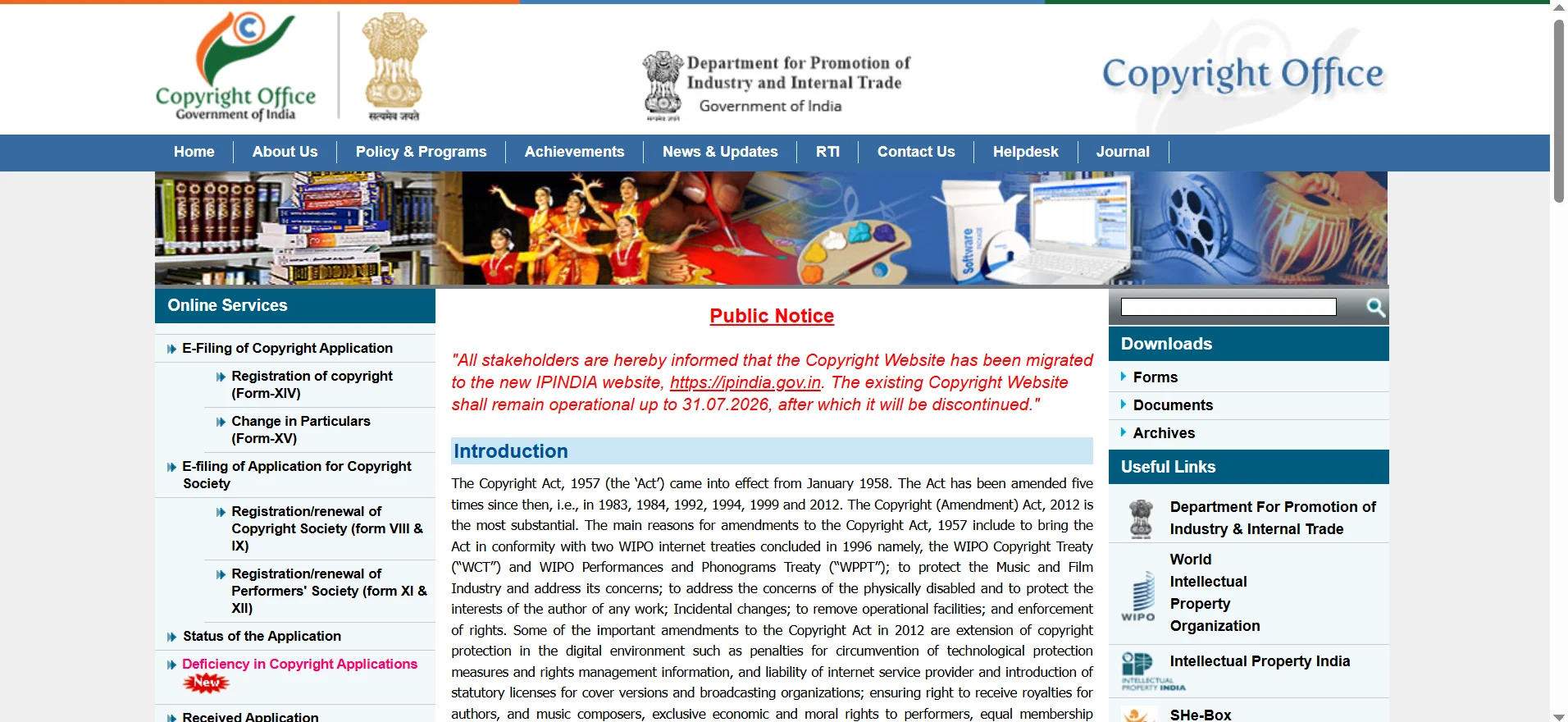
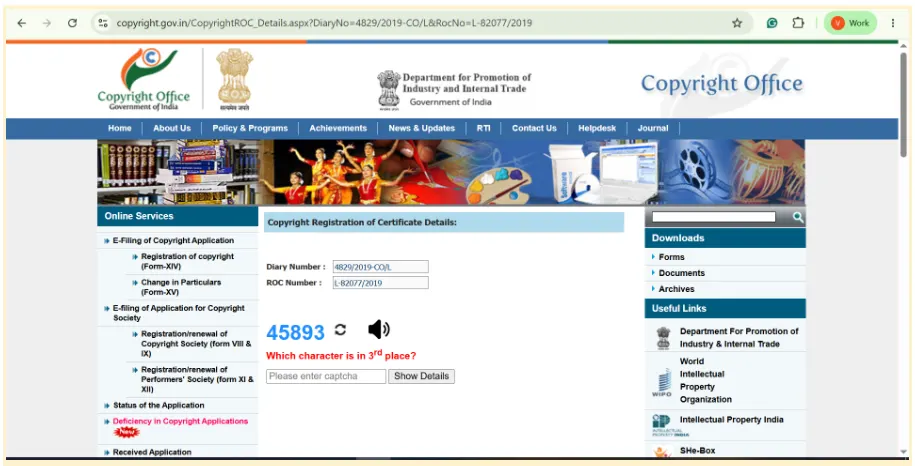
You can track your copyright application at any stage using the official Copyright Office portal. Here's how:
Once your application is approved, the Registrar records it in the Register of Copyrights and issues the Registration Certificate.
Once your application status shows "Registered," you can download your certificate directly from the Copyright Office portal. Here's how:
Important: Physical certificates are no longer issued, following the Copyright (Amendment) Rules, 2021. The downloaded digital extract is your official, legally valid certificate; no separate physical copy will be sent by post.
During the mandatory 30-day waiting period following filing, any third party may raise a formal objection. This applies if they believe the work in question is not original or infringes upon their existing rights. The process unfolds as follows:
A copyright owner may transfer some or all of their rights to another person or entity through a formal assignment. The following provisions apply:
Creators and businesses often confuse these three forms of intellectual property. Here's how they differ:
| Basis | Copyright | Trademark | Patent |
| What It Protects | Original creative expression, literary, artistic, musical, dramatic works, films, sound recordings, and software | Brand identifiers, names, logos, symbols, taglines | Inventions, new products, or processes with a technical solution |
| Governing Law | Copyright Act, 1957 | Trade Marks Act, 1999 | Patents Act, 1970 |
| Registration Requirement | Not mandatory; protection is automatic upon creation | Not mandatory, but registration strengthens enforcement | Mandatory; no protection exists without registration |
| Duration of Protection | Life of the author plus 60 years (60 years from publication for films/recordings) | 10 years, renewable indefinitely | 20 years from the filing date, non-renewable |
| Governing Authority | Copyright Office, under DPIIT | Trade Marks Registry, under CGPDTM | Indian Patent Office, under CGPDTM |
| Example | A novel, a song, a film, or software code | A brand's name and logo | A new drug formula or a mechanical device |
Many businesses need both copyright and trademark protection. For example, a logo can be protected as an artistic work under copyright and as a device mark under trademark law.
Connect with Startupease and let our experts handle
the legal hassle while you grow your business.