
Read More
India has emerged as one of the most promising destinations to invest in startups, driven by rapid digital growth and a large, young population. As per the Ministry of Commerce &...
Simplify your tax season with Startupease expert-led income tax return filing services. We ensure accurate ITR e-filing, personalized assistance, and maximum deductions, keeping you compliant and penalty-free.
 Simple & Fast Filing ProcessPersonalized Assistance from Tax ExpertsMaximize Eligible Deductions & Refunds100% Compliance with Tax LawsTrusted by Individuals & Businesses Nationwide
An Income Tax Return (ITR) is a mandatory annual declaration filed by individuals and businesses with the Income Tax Department of India. It details all income earned from various sources (like salary, business, property, capital gains, and other sources) during a specific financial year.
By submitting an ITR, taxpayers comply with legal requirements, establish proof of income for financial dealings, and facilitate the accurate assessment of their tax obligations to the government.
Income Tax Return (ITR) filing is the annual process where individuals and entities report their earnings and claim deductions to the Income Tax Department of India. This declaration involves submitting a specific ITR form that details all income sources (like salary, business profits, or capital gains) and claims eligible tax-saving deductions, such as Section 80C for life insurance premiums, PPF, and EPFcontributions, and Section 80D for health insurance premiums.
The ITR form that a taxpayer needs to file depends on the nature and complexity of their income. There are different forms (ITR-1, ITR-2, ITR-3, etc.), each tailored for specific types of income and taxpayers.
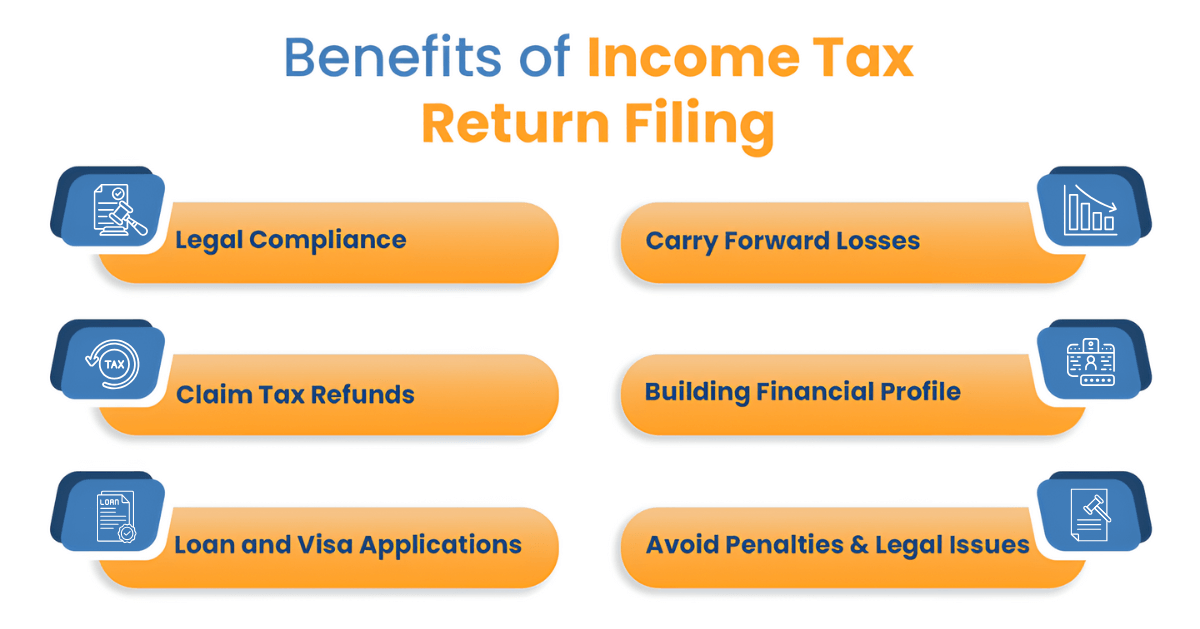
Filing your income tax return offers significant benefits that go beyond just legal compliance. It helps you to:
In Income Tax Return (ITR) filing, understanding the distinction between the Financial Year (FY) and the Assessment Year (AY) is fundamental. While often confused, they represent different periods for income earning and tax assessment.
| Feature | Financial Year (FY) | Assessment Year (AY) |
| Definition | The year in which you earn your income. | The year in which the income earned in the Financial Year is assessed and taxed. |
| Period | Always starts on April 1st and ends on March 31st of the following calendar year. | Always starts on April 1st and ends on March 31st of the year succeeding the Financial Year. |
| Purpose | Period for income generation, expenses incurred, and financial transactions. | Period for filing Income Tax Returns (ITR), calculating tax liability, and paying taxes on the income earned in the preceding FY. |
| Examples | FY 2025-26: April 1, 2025, to March 31, 2026 (Income earned during this period). | AY 2026-27: April 1, 2026, to March 31, 2027 (ITR filed for income earned in FY 2025-26). |
| ITR Form | Income is earned during this period, but you don't file an ITR for the FY itself. | All Income Tax Return (ITR) forms explicitly ask for the Assessment Year, not the Financial Year, as you are assessing past income. |
| Relation | The Assessment Year is always the year immediately following the Financial Year. | The Financial Year is always the year immediately preceding the Assessment Year. |
Understanding the applicable tax slabs is crucial for accurate income tax return filing. India offers two tax regimes:
The New Tax Regime (default from FY 2023-24) offers lower tax rates but fewer deductions and exemptions. For individuals, the tax slabs for FY 2025-26 (AY 2026-27) are:
| Income Slabs (Rs.) | Income Tax Rate (%) |
| 0 - 4,00,000 | Nil |
| 4,00,001 - 8,00,000 | 5 |
| 8,00,001 - 12,00,000 | 10 |
| 12,00,001 - 16,00,000 | 15 |
| 16,00,001 - 20,00,000 | 20 |
| 20,00,000 - 24,00,000 | 25% |
| Above 24,00,000 | 30% |
(₹12 Lakh rebate applicable under new regime for tax calculation)
Section 87A provides tax relief to resident individuals falling under lower income brackets by offering a rebate on tax payable. For FY 2025-26:
Under the new tax regime, a rebate of ₹25,000 is available for a total income up to ₹7 lakh.
Under the old tax regime, a rebate of ₹12,500 is available for a total income up to ₹5 lakh.
From FY 2025-26 (AY 2026-27) onwards, the rebate under the new tax regime has been significantly enhanced. A rebate of ₹60,000 is now available for resident individuals with total income up to ₹12 lakh, effectively making such income fully tax-free.
As a result, marginal relief, which earlier applied to income marginally exceeding ₹7 lakh, will now apply to income slightly above ₹12 lakh, ensuring taxpayers do not face a disproportionate tax burden for small income increases.
Further, salaried taxpayers under the new tax regime can claim a standard deduction of ₹75,000, making income up to ₹12.75 lakh effectively tax-free.
The Old Tax Regime allows taxpayers to claim various deductions and exemptions (e.g., 80C, HRA, LTA). The slabs under the old regime depend on the taxpayer's age:
For Individuals below 60 years and HUF:
| Income Slabs (Rs.) | Income Tax Rate (%) |
| 0 - 2,50,000 | 0 |
| 2,50,001 - 5,00,000 | 5 |
| 5,00,001 - 10,00,000 | 20 |
| Above 10,00,000 | 30 |
For Senior Citizens (60 years to less than 80 years):
| Income Slabs (Rs.) | Income Tax Rate (%) |
| 0 - 3,00,000 | 0 |
| 3,00,001 - 5,00,000 | 5 |
| 5,00,001 - 10,00,000 | 20 |
| Above 10,00,000 | 30 |
For Super Senior Citizens (80 years and above):
| Income Slabs (Rs.) | Income Tax Rate (%) |
| 0 - 5,00,000 | 0 |
| 5,00,001 - 10,00,000 | 20 |
| Above 10,00,000 | 30 |
Let's illustrate with examples for FY 2025-26 (AY 2026-27):
Example Scenario: Mr. Sharma, aged 40, is a salaried employee with a gross annual salary of Rs. 15,00,000. He pays Rs. 2,00,000 in house rent annually and has made the following investments:
Under the Old Tax Regime, Mr. Sharma can claim various deductions and exemptions to reduce his taxable income.
Income Calculation (Old Regime):
Taxable Income: 15,00,000 − 50,000 −1,00,000 − 1,50,000 − 1,50,000 − 25,000 = Rs.10,25,000
Tax Calculation (Old Regime - for individuals below 60 years for FY 2025-26):
Total Tax before Cess: 12,500 + 1,00,000 + 7,500 = Rs. 1,20,000
Add: 4% Health and Education Cess: 4% of 1,20,000 = Rs. 4,800
Total Tax Payable (Old Regime): 1,20,000 + 4,800 = Rs. 1,24,800
Under the New Tax Regime, Mr. Sharma cannot claim most of the common deductions and exemptions like HRA, Section 80C, Section 80D, or interest on a self-occupied housing loan. However, he benefits from lower tax slab rates and an enhanced standard deduction.
Income Calculation (New Regime):
Tax Calculation (New Regime for FY 2025-26 / AY 2026-27):
Total Tax before Cess: ₹20,000 + ₹40,000 + ₹33,750 = ₹93,750
Add: 4% Health and Education Cess: 4% of ₹93,750 = ₹3,750
Total Tax Payable (New Regime): ₹93,750 + ₹3,750 = ₹97,500
Conclusion for Mr. Sharma: Under the New Tax Regime, Mr. Sharma’s total tax liability comes to ₹97,500 for FY 2025-26 after claiming the standard deduction of ₹75,000.
This demonstrates how the optimal choice depends heavily on an individual's financial planning and the quantum of eligible deductions they can claim. Taxpayers must carefully evaluate both regimes based on their specific financial situation before filing their ITR.
The choice between the old and new tax regimes depends largely on the deductions and exemptions you plan to claim. If you have significant tax-saving investments and expenses, the old regime might be more beneficial. If you prefer simplicity and fewer deductions, the new regime could be better.
Connect with experts and make an informed decision for your income tax return filing.
Tax rates vary based on the entity type. While individuals and HUFs follow the slab rates, companies have different tax structures. Domestic companies can opt for various concessional rates (e.g., 22% under Section 115BAA, 15% under Section 115BAB) based on certain conditions, or a standard rate of 25%/30% depending on turnover. Surcharge and cess are applicable in addition to the base tax rates.
Generally, any individual or entity whose gross total income exceeds the basic exemption limit is required to file an ITR. Refer to the tax slabs mentioned above for the specific exemption limits under both the Old and New Tax Regimes for FY 2025-26.
This includes:
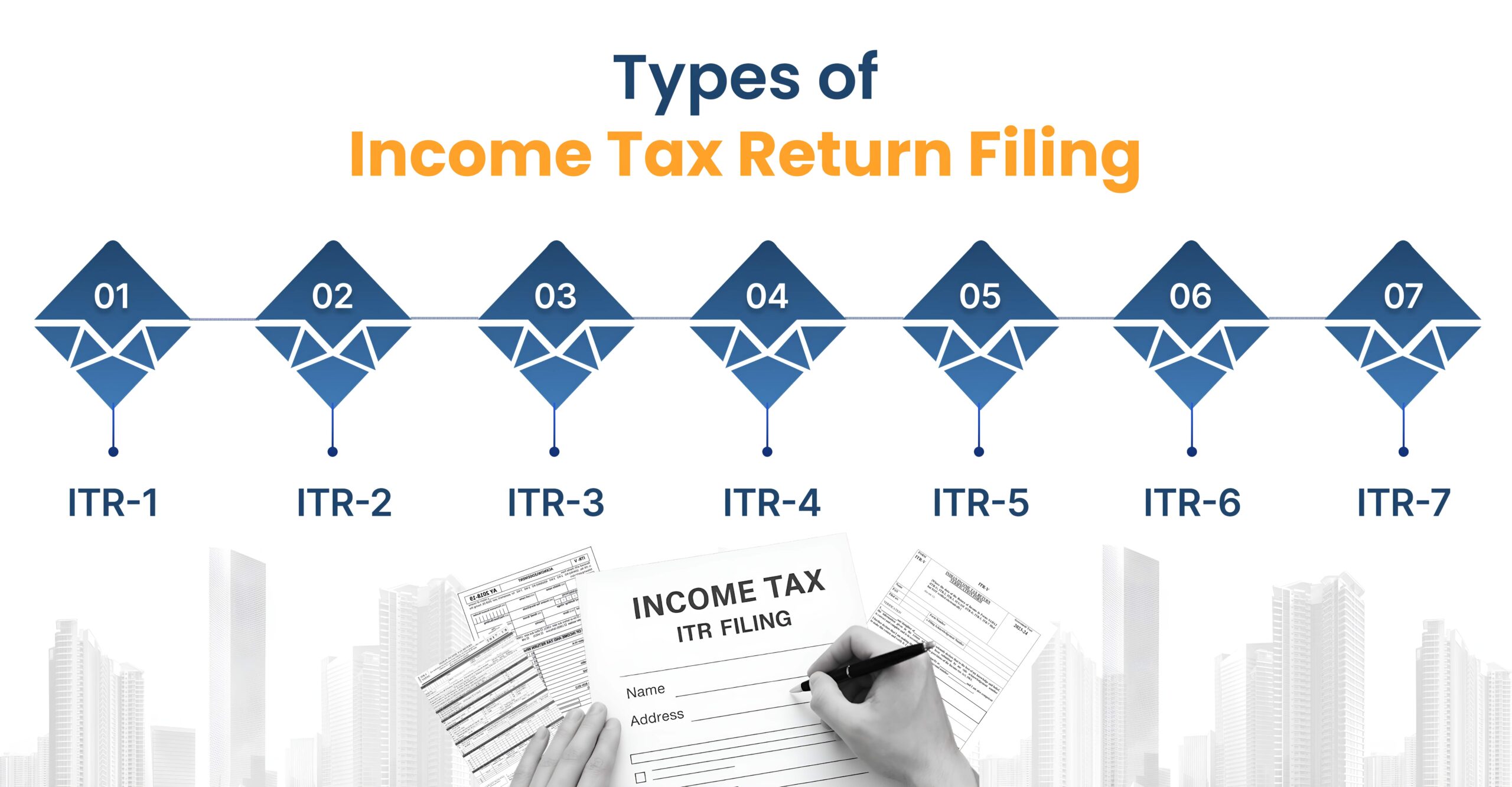
Selecting the right ITR form is a critical step in how to file an income tax return. Choosing an incorrect form can lead to your return being treated as defective.
| Form Name | Applicable To | Types of Income Covered | Exclusions |
| ITR-1 (SAHAJ) | Salaried Individuals, Pensioners, and Residents (Income ≤ Rs. 50 lakh). | Salary or Pension Income, Income from one house property (excluding losses brought forward), Income from other sources (e.g., savings account interest), Agricultural income up to Rs. 5,000. | Capital gains, Business or professional income, Foreign assets. |
| ITR-2 | Individuals and Hindu Undivided Families (HUFs) with income other than business or profession. | Salary or Pension Income, Income from more than one house property, Capital gains (short-term/long-term, including Section 112A), Income from other sources (e.g., lottery, foreign dividends), Income from foreign assets. | Income from profits and gains of business or profession. |
| ITR-3 | Individuals and HUFs with business income. | Income from proprietorship business, Professional income (e.g., doctors, lawyers), Income from partnership firm, Salary, house property, capital gains, and other sources. | None (Comprehensive form for all income streams, including business income). |
| ITR-4 (SUGAM) | Small Businesses and Professionals under Presumptive Taxation Schemes. | Resident individuals, HUFs, and firms (excluding LLPs), Income under Section 44AD, 44ADA, or 44AE (presumptive taxation schemes). | Income exceeding Rs. 50 lakh, Detailed accounting requirements (as income is presumed). |
| ITR-5 | Firms, LLPs, AOPs, BOIs, AJPs, Co-operative Societies, and Local Authorities. | Applicable to entities like firms, LLPs, co-operative societies, etc. | Not applicable for individuals, HUFs, or companies claiming exemptions under Section 11 of the Act. |
| ITR-6 | Companies (excluding those claiming exemption under Section 11). | Companies. | Companies claiming exemptions under Section 11 (e.g., income from property held for charitable purposes). |
| ITR-7 | Persons (including companies) required to file under specific sections of the Income Tax Act. | Charitable or religious trusts (Section 139(4A)), Political parties (Section 139(4B)), Scientific research institutions, universities (Section 139(4C)), Educational institutions (Section 139(4D)). | None (Specific to entities required under the sections mentioned). |
2026 Update: For AY 2025-26 / FY 2024-25, new Excel utilities for ITR-1 and ITR-4 were released by the Income Tax Department. Additionally, schema changes have occurred in ITR-1, ITR-2, and ITR-5 formats, which affect field names and schedules. So taxpayers should always use the latest forms from the e-filing portal.
Having these documents ready will significantly speed up your income tax return filing process.
Our streamlined income tax return filing process ensures that you can complete your tax obligations with ease.
The foundation of accurate income tax return filing lies in having all your financial documents meticulously organized. Before you even begin the e-filing process, ensure you have gathered all relevant paperwork. This typically includes:
Having these readily available will significantly streamline the data entry and verification process.
Once your documents are in order, compute your total taxable income. This involves consolidating income from all five major heads as per the Income Tax Act:
Our process helps you systematically account for each income stream to arrive at your Gross Total Income before any deductions.
After calculating your Gross Total Income, claim all applicable deductions under various sections of the Income Tax Act. This is where significant tax savings can be achieved. Our guidance ensures you do not miss out on any eligible deductions, such as:
With all your income, deductions, and tax computations finalized, prepare and upload your ITR. This involves entering all the compiled information into the chosen ITR form (ITR-1, ITR-2, etc.) on the official Income Tax e-filing portal.
Many details, such as personal information and TDS/TCS data from Form 26AS and Annual Information Statement (AIS), are often pre-filled, which should be carefully verified. We assist in ensuring all fields are accurately populated, any balance tax payable is paid (self-assessment tax), and the return is generated in the correct format (usually JSON) for seamless upload to the portal.
The submission of your ITR is incomplete until it is e-verified. E-verification is a mandatory final step that validates your e-filing of the income tax return and signifies your authentication of the data submitted. Without successful e-verification, your ITR will not be processed by the Income Tax Department and will be treated as if it were never filed.
We guide you through the various convenient methods available for e-verification:
Tax compliance is crucial, and understanding the deadlines and consequences of late filing is key to a smooth income tax return filing experience.
The charges for ITR (Income Tax Return) filing in India vary significantly based on how you choose to file and the complexity of your income. Here's a breakdown:
For Financial Year 2025-26 (Assessment Year 2026-27), the due dates for filing Income Tax Returns are as follows:
If you miss the original due date for income tax return filing, Section 234F of the Income Tax Act imposes a mandatory late filing fee.
This penalty for late filing of the income tax return is designed to encourage timely compliance:
Beyond the late filing fee, significant interest charges can apply if there is any unpaid tax liability. These are levied under different sections of the Income Tax Act:
Missing the deadline for income tax return filing has several significant consequences beyond just monetary penalties and interest:
Therefore, it is always advisable to file your income tax return by the stipulated due date to avoid penalties, interest, and other adverse consequences.
Understanding and claiming available deductions is a key benefit of filing an income tax return.
Section 80C is one of the most widely utilized sections for tax saving, allowing a maximum deduction of Rs. 1.5 lakh from your gross total income. This deduction can be claimed by individuals and Hindu Undivided Families (HUFs) for investments made in various specified instruments and certain expenditures.
Key eligible investments and expenses include:
Section 80D allows deductions for health insurance premiums paid, promoting healthcare savings. This deduction is available to individuals and HUFs. The limits vary based on who is covered:
Additionally, a deduction of up to Rs. 5,000 for preventive health check-ups is also allowed within these limits, payable in cash. This section is a significant tool for lowering your taxable income during income tax return filing.
Interest paid on a home loan can provide substantial tax benefits. This deduction is available under Section 24(b) of the Income Tax Act. The amount you can claim depends on whether the property is self-occupied or let out:
Any unadjusted loss can be carried forward for 8 subsequent assessment years. This deduction is a major component for individuals having a housing loan, significantly impacting their income tax return filing.
The Standard Deduction is a fixed deduction allowed to all salaried individuals from their gross salary income. For Financial Year 2025-26 (Assessment Year 2026-27), the standard deduction for salaried employees is Rs. 50,000. This deduction is available irrespective of whether you opt for the Old Tax Regime or the New Tax Regime.
It was reintroduced in Budget 2018, replacing the earlier deductions for transport allowance and medical reimbursement. It simplifies income tax return filing for salaried individuals by providing a standard deduction without the need to submit proofs for specific expenses.
From FY 2024-25 onwards, the standard deduction has been increased to ₹75,000 for salaried taxpayers under the new tax regime, as confirmed by the Finance Act, 2024. This deduction continues to apply for FY 2025-26 (Assessment Year 2026-27), helping reduce taxable income without any additional compliance.
Beyond the popular sections mentioned above, several other deductions can further reduce your taxable income during income tax return filing:
Filing your Income Tax Return (ITR) can seem daunting, and even small errors can lead to notices from the Income Tax Department, penalties, or delayed refunds. Here are some of the most common mistakes taxpayers make while filing their ITR:
Checking your Income Tax Return (ITR) e-filing status is crucial to ensure your return has been processed correctly and to track any potential refund. Here's how to do it:
Finalizing your income tax return filing journey involves a critical step: verification. This section elaborates on the importance of this final action, various methods for its completion, how to monitor your refund, and how to effectively respond to any notices from the Income Tax Department.
E-verification is the digital confirmation that the Income Tax Return (ITR) you have filed is indeed genuine and submitted by you. It is a mandatory step to complete the e-filing of the income tax return process. Without successful e-verification within the stipulated time limit (currently 30 days from the date of filing for returns filed on or after August 1, 2022), your ITR will be considered invalid, meaning it will be treated as if you never filed it.
Consequently, the Income Tax Department will not process your return, and any tax refund due to you will not be issued. E-verification ensures the authenticity and integrity of your tax submission, crucial for the department to initiate processing under Section 143(1) of the Income Tax Act.
The Income Tax Department offers multiple convenient methods for e-verifying your ITR, allowing taxpayers to choose the option that best suits them. This ensures a hassle-free completion of your income tax return filing:
If you are expecting a tax refund after your income tax return filing, you can easily track its status online. This allows you to monitor the progress of your refund and take necessary action if there are delays. You can typically check your refund status through two primary platforms:
Receiving an income tax notice can be unsettling, but it's a common occurrence for various reasons, such as discrepancies found in your filed return, requests for additional information, or selection for scrutiny. When you receive a notice related to your income tax return filing:
Connect with Startupease and let our experts handle
the legal hassle while you grow your business.