Read More
India has emerged as one of the most promising destinations to invest in startups, driven by rapid digital growth and a large, young population. As per the Ministry of Commerce &...
Obtain your BIS Certification online in India with Startupease. Our experts handle ISI and CRS registration end-to-end — documentation, application filing, and compliance with applicable Indian standards.

BIS certification is an essential compliance requirement for businesses manufacturing, importing, or selling regulated products in the Indian market today. The Government of India has notified 187 Quality Control Orders (QCOs) covering 769 product categories under mandatory BIS certification requirements by June 2026. The Ministry of Heavy Industries, the Ministry of Electronics and Information Technology, and the Department for Promotion of Industry and Internal Trade issue these orders.
The scope continues to expand each year as the government tightens consumer safety and import regulations.
For manufacturers, importers, and traders, BIS certification is no longer just a legal formality or routine paperwork. Businesses cannot manufacture, import, sell, or distribute products covered under mandatory QCOs without a valid BIS Certification. The framework covers a wide range of goods, including electronics, steel, chemicals, machinery, footwear, and gold jewelry.
The Bureau of Indian Standards (BIS) serves as India’s national standards body responsible for setting quality benchmarks for products and systems. It defines Indian Standards (IS) that ensure safety, reliability, and consistency across regulated industries.
BIS operates under the BIS Act, 2016, under the Ministry of Consumer Affairs, Food and Public Distribution. It develops standards, evaluates conformity, and grants product certifications to ensure compliance with national quality requirements.
BIS also administers product marking systems that indicate compliance with applicable Indian Standards. The ISI mark applies to Scheme-I products, while electronic products registered under CRS receive a unique registration number. These marks help regulators, buyers, and customs authorities identify products that meet required safety and quality norms.
The mandatory BIS product list covers several industries and continues to expand through newly notified Quality Control Orders. Businesses should identify the applicable Indian Standard and certification scheme for their products before planning manufacturing, imports, or commercial sales. BIS currently regulates products across the following major categories:
The Bureau of Indian Standards offers different certification schemes depending on the product and compliance requirements. The following are the major BIS registration schemes used in India:
The ISI Mark Scheme applies to products that require factory inspection, product testing, and continuous surveillance before BIS grants a license. This scheme covers several consumer and industrial products, including cement, steel, electrical appliances, pressure cookers, and packaged drinking water. Manufacturers receive permission to use the ISI Standard Mark after successfully meeting the applicable Indian Standard requirements.
The Compulsory Registration Scheme applies to notified electronic and information technology products regulated by the Ministry of Electronics and Information Technology. Manufacturers must test their products in a BIS-recognized laboratory before obtaining registration under this scheme. Unlike the ISI Mark Scheme, CRS generally does not require a factory inspection before registration.
The Foreign Manufacturers Certification Scheme allows overseas manufacturers to obtain a BIS license for products exported to India. Foreign applicants must appoint an Authorized Indian Representative and complete factory inspection, testing, and approval before supplying regulated products in India.
Scheme X applies to specific products notified under the Safety of Machinery and Electrical Equipment Regulations and other applicable Quality Control Orders. Manufacturers must demonstrate compliance with the organization's relevant Indian Standards through product evaluation, factory assessment, and the certification requirements prescribed under Scheme X.
BIS also provides certification for organizations that follow standard management systems. This includes:
This scheme certifies organizational management systems instead of individual products.
The following benefits explain why manufacturers and importers should obtain BIS certification:
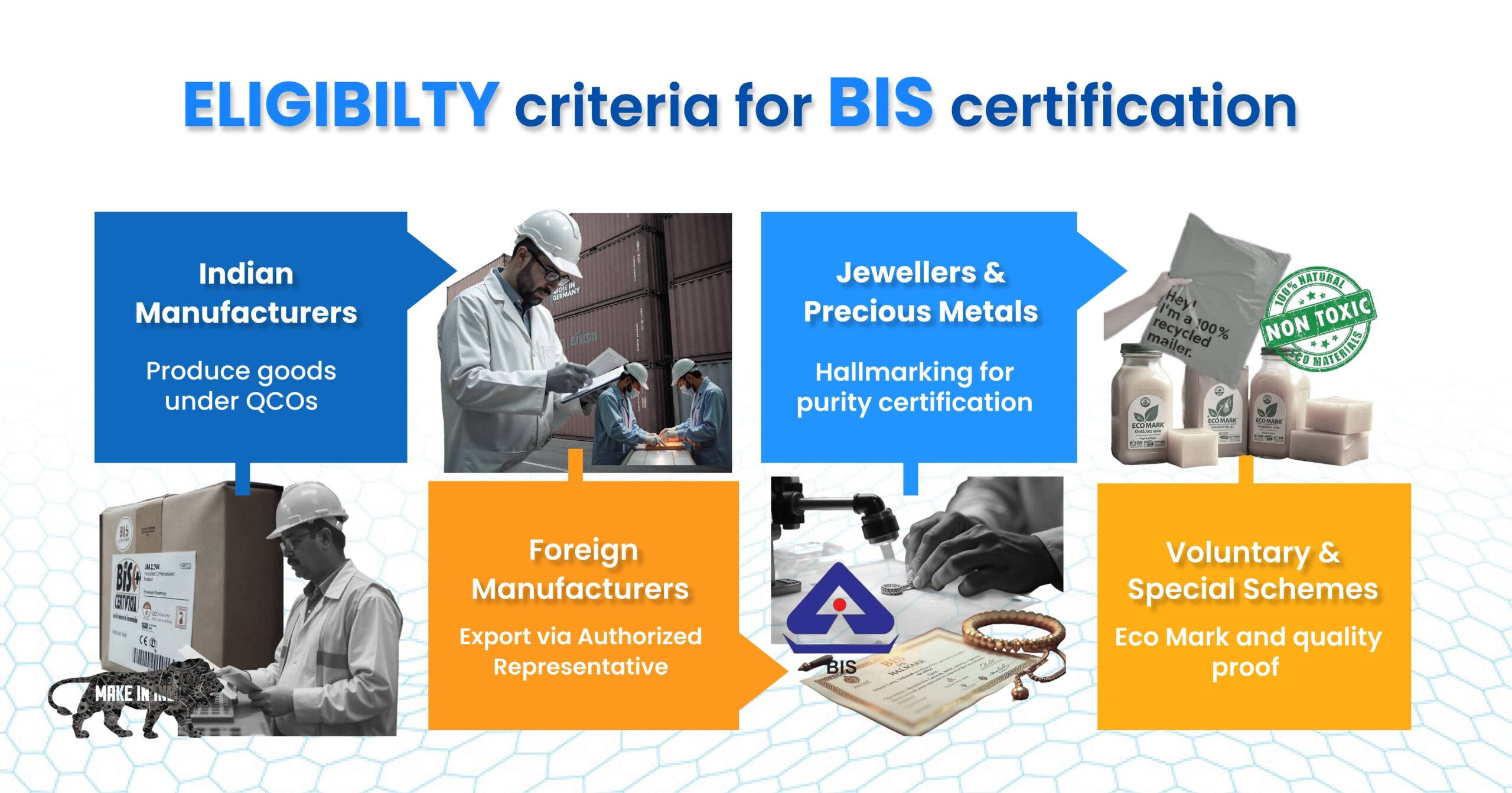
To obtain BIS certification in India, applicants must satisfy the following eligibility requirements:
The documents required for BIS certification depend on the chosen scheme, product category, and manufacturer location. The table below presents the complete list of documents:
| Category | Document | Purpose |
| Business & Legal | Certificate of Incorporation | Confirms the legal existence of the company |
| Memorandum and Articles of Association (MoA & AoA) | Establishes the company's scope and structure | |
| Partnership Deed or Proprietorship Proof | Verifies the legal form of non-corporate applicants | |
| GST Registration Certificate | Proves tax registration in India | |
| PAN Card of the Company | Confirms tax identity with Indian authorities | |
| MSME or Udyam Registration (if applicable) | Helps avail MSME fee concessions from BIS | |
| Authorized Signatory | Authorization Letter for Signatory | Names the person empowered to sign the application |
| ID and Address Proof of Signatory | Verifies the identity of the authorised person | |
| Factory & Manufacturing | Factory Layout Plan | Maps the production area and process flow |
| Manufacturing Process Flow Chart | Shows each step from raw material to finished product | |
| List of Plant and Machinery | Confirms the technical capacity of the factory | |
| List of In-house Testing Equipment | Demonstrates the quality control infrastructure | |
| Calibration Certificates of Test Equipment | Proves the accuracy of in-house measuring instruments | |
| Quality Control Manual | Records the internal quality assurance system | |
| Product & Technical | Product Specification Sheet | Lists product dimensions, materials, and ratings |
| Technical Drawings and Circuit Diagrams | Provides design-level product details | |
| Bill of Materials (BoM) | Identifies all components and critical parts | |
| List of Critical Components with Brands | Confirms safety-critical part details | |
| Product User Manual | Helps assess intended use and safety warnings | |
| Trademark or Brand Authorization Letter | Confirms ownership or right to use the brand name | |
| Testing | Test Report from BIS-Recognized Laboratory | Proves product conformity to the relevant IS |
| Test Report Validity (within 90 days) | BIS accepts only fresh test reports under CRS | |
| NABL Accreditation Proof of Test Lab | Confirms the lab's accreditation status | |
| Foreign Manufacturer (FMCS) | Authorised Indian Representative (AIR) Nomination Letter | Appoints the legal liaison based in India |
| AIR Address and ID Proof | Verifies the identity and residence of the AIR | |
| Business Registration Document from Home Country | Confirms the legal existence of the foreign entity | |
| Performance Bank Guarantee (USD 10,000) | Mandatory financial security for foreign applicants | |
| Power of Attorney to the AIR | Empowers the AIR to act on behalf of the manufacturer | |
| Declarations & Undertakings | Declaration of Conformity to Indian Standard | Confirms ongoing compliance with the relevant IS |
| Self-Declaration of Marking and Labelling | States how the BIS mark will appear on the product | |
| Undertaking Surveillance Audits | Confirms willingness to accept BIS inspections | |
| Hallmarking-Specific | Jeweller's BIS Registration Certificate | Confirms BIS registration as a jeweller |
| List of Sales Outlets | Maps all locations where hallmarked items will be sold | |
| Affidavit on Letterhead | Declares the correctness of all furnished information |
The BIS registration process may appear complex, but a structured approach helps you obtain the certificate smoothly and efficiently:
Begin by determining which specific Indian Standard (IS) applies to your product. Research whether your product falls under the mandatory ISI Mark, CRS, or other schemes.
Gather all the documents required for BIS certification, including company registration, manufacturing process details, quality control records, and product specifications. Please refer to the above section “Documents Required for BIS Certification in India” for detailed information.
Submit the BIS certification application online through the BIS Manakonline portal in Form V (ISI Mark) or Form I (CRS). Fill in all the required details, upload the prescribed documents, and pay the applicable fee. Ensure that the information provided is accurate and consistent with the supporting documents to facilitate smooth processing by BIS officials.
For CRS products, manufacturers must test product samples at a BIS-recognized laboratory. This report must be less than 90 days old at the time of application.
For ISI Mark products, BIS officials collect samples during factory inspection and send them to a BIS-approved laboratory for testing.
BIS officials will inspect your manufacturing facility to assess your production processes, quality control systems, and in-house testing facilities. This step ensures your factory produces goods meeting BIS standards, with foreign manufacturers required to coordinate inspections under FMCS through an Indian representative or an agent.
BIS scrutinizes your application and audit reports. They may raise queries or request additional information or documentation. Respond promptly and accurately to all clarifications to keep the BIS registration process moving forward.
Once BIS is satisfied that your product and manufacturing processes comply with the standard, they will grant you:
This allows you to apply the appropriate BIS mark to your products.
The BIS certification cost in India is not fixed and varies based on several factors, while non-compliance carries significant penalties.
The total BIS certification cost depends on the specific scheme, product type, complexity of manufacturing, size of the organization, and whether you use a consultant.
| Fee Type | Amount (₹) | Notes |
| Application Fee | 1,000 | One-time, non-refundable |
| Processing Fee (includes 1 test report) | 25,000 | Additional test report: 10,000 each |
| Annual Registration Fee (2 years) | 2,000 (1,000 x 2) | For two years validity |
| Total (for 1 test report) | 28,000 + GST | |
| Inclusion (add new model/variety) | 15,000 + 10,000 per extra test report | |
| Renewal | 28,000 + GST | For 2 years |
| Fee Type | Amount (₹) | Notes |
| Application Fee | 1,000 | Non-refundable |
| Audit/Inspection Fee | 7,000 per man-day of the visiting BIS officer | For factory inspection, the duration may vary |
| Sample Test Fee | As applicable | Varies by product and laboratory |
| License Fee | 1,000 | |
| Minimum Marking Fee | As per the IS Standard | Varies by product category |
| Annual License Fee | 1,000 | |
| Inclusion Fee | 5,000 | For adding new products under the same license |
| Fee Type | Amount (₹) | Notes |
| Application Fee | 1,000 | Non-refundable |
| Factory Inspection Charges | 7,000 per man-day | For the BIS officials’ on-site audit |
| Testing Charges | As applicable | Varies by product and laboratory |
| License/Certificate Fee | Varies | Depends on product and duration |
| Renewal Fee | Varies | Based on the validity period (1–5 years) |
| Marking Fee | As per the product |
Selling products that require mandatory BIS certification without a valid BIS certificate can lead to strict penalties:
The validity of a BIS certificate varies based on the type of certification.
Manufacturers must apply for renewal through the BIS Manak online portal before expiry. They must submit updated documents, pay renewal fees, and ensure continued compliance with BIS standards. BIS may also review past compliance before approving renewal.
After obtaining BIS certification, businesses must comply with the following requirements:
To download a BIS certificate, follow these steps:
Connect with Startupease and let our experts handle
the legal hassle while you grow your business.