Read More
India has emerged as one of the most promising destinations to invest in startups, driven by rapid digital growth and a large, young population. As per the Ministry of Commerce &...
Draft a legally sound Memorandum of Understanding (MoU) in India with RegisterKaro. Clearly define mutual goals, roles, and terms, without the hassle of a complex legal contract.
 Custom MoU Drafting by Legal ExpertsClear Terms & Mutual ResponsibilitiesReviewed for Legal ValidityEditable & Ready-to-Use FormatQuick Turnaround & On-Time Drafting
MoU full form is Memorandum of Understanding, which is a written document where two or more parties agree to work together. It outlines shared goals, responsibilities, and important terms, without creating a formal legal contract.
MoUs are commonly used at the early stages of a partnership. They help all parties stay aligned, avoid confusion, and set clear expectations. By putting everything in writing, an MoU builds trust and acts as a roadmap for future agreements.
In most situations, an MoU is not legally binding. However, it still holds value. It shows that the parties are serious about working together and helps guide the next steps.
In India, MoUs do not need to be registered. But they are often printed on stamp paper to add legal credibility. The required stamp duty can differ depending on the state.
Although an MoU is generally not enforceable by law, certain clauses like confidentiality, dispute resolution, or jurisdiction, can be legally binding if written and agreed upon by all parties.
Ultimately, an MoU serves as a smart, flexible way to document mutual understanding before entering into a formal contract.
Since an MoU is generally not a legally binding contract, it is not mandatory to print it on stamp paper.
However, if your MoU involves terms that could be legally enforceable (like a confidentiality clause or a transfer of money), it is a very good practice to print it on a stamp paper of appropriate value. This gives the document more legal weight and makes it more likely to be admitted as evidence in court if a dispute arises.
While an MoU is typically not a legally binding contract, it is an incredibly useful tool, especially in the early stages of a partnership.
Here’s why your business needs one:
In India, MoUs are widely used in:
Essentially, an MoU helps structure early conversations, formalize intent, and create a path toward long-term collaboration, without the risks of rushing into a binding contract.
An MoU works as a flexible agreement. It records the mutual understanding between parties before they are ready to sign a detailed, legally enforceable contract.
Imagine two companies want to work on a joint marketing campaign. They can sign an MoU that outlines:
This MoU allows them to start planning and working together. Later, once all the details are finalized, they can sign a formal contract that is based on the terms laid out in the MoU.
An MoU has some unique features that make it different from other documents:
Many people assume that an MoU carries no legal weight. While this is often true, the legal status of an MoU depends on how it is written and what it contains.
In general, most MoUs in India are not legally binding. They are designed to record a shared understanding between parties, not to create enforceable rights or obligations. MoUs help clarify intentions, but they typically stop short of forming a contract.
Most MoUs are not legally binding because they are missing the key elements that make a document a legal contract. For example:
So, if you sign a typical MoU and the other party backs out, you usually cannot sue them for breach of contract.
However, there is a very important exception. Under the Indian Contract Act, 1872, if an MoU meets certain conditions, it can be treated as a legally binding contract.
An MoU can become legally binding if:
Substance Over Title
Indian courts often look beyond the title "MoU." They focus on the substance of the document, not what it's called. If the terms are precise and show clear intent, the document may be upheld as legally binding.
The Golden Rule: If an MoU looks like a contract, smells like a contract, and acts like a contract, an Indian court might just treat it as one. It all comes down to the words used in the document and the actions of the parties.
People often use these terms interchangeably, but they have different legal meanings. Let's clear up the confusion.
| Feature | Memorandum of Understanding (MoU) | Agreement | Contract |
| Legally Binding | Usually not legally binding. It shows an intention to agree. | It can be legally binding or not. It's a broader term. | Always legally binding and enforceable in a court of law. |
| Enforceability | Generally not enforceable in court. | An agreement can become a contract if it meets certain criteria. | Legally enforceable. You can sue for breach of contract. |
| Purpose | To outline a common understanding and form a basis for a future contract. | To define the terms of a promise or a set of promises. | To create a legally binding obligation between two or more parties. |
| Formality | Less formal. | Can be formal or informal. | More formal, with specific legal requirements. |
| Example | Two companies planning a joint venture sign an MoU. | Two companies are agreeing to share their market data. | A company signs an employment agreement with a new employee. |
In simple terms, all contracts are agreements, but not all agreements are contracts. An MoU is a type of agreement that is usually not a contract.
This is another common point of confusion, especially for people starting a company. MoU and MOA sound similar, but they are completely different documents.
In short, an MoU is for partnerships and collaboration between parties, while an MOA is for company incorporation.
MoUs are incredibly versatile. They can be used in a wide variety of situations where parties want to collaborate without immediately entering into a formal contract.
Here are some common scenarios where an MoU is used:
A well-drafted MoU is clear, concise, and covers all the important points. While there is no strict legal format, a good MoU draft should include the following sections.
This is an optional but commonly used section at the beginning of an MoU. It contains a series of statements, each starting with the word “WHEREAS,” that explain the background and reasons behind the agreement.
These clauses help set the context by outlining the shared understanding, past interactions, or intentions of the parties. While not legally required, including them adds clarity and helps readers quickly grasp why the MoU is being created.
This section identifies all the parties entering into the MoU. It should include their full legal names, addresses, and other relevant details.
This is the heart of the MoU. It clearly and simply states the main purpose of the collaboration. What are the parties trying to achieve together? The goals should be specific and measurable.
This section details what each party is expected to do. It outlines the specific tasks, duties, and contributions of everyone involved. This helps prevent confusion about who is responsible for what.
If the collaboration involves money, this section is very important. It should outline:
This clause specifies how long the MoU will be in effect. It should also explain how and when the MoU can be ended (terminated) by the parties.
During a collaboration, parties often share sensitive information. A confidentiality clause ensures that both parties agree to keep this information private and not disclose it to others. This clause is often intended to be legally binding.
What happens if there is a disagreement? This clause outlines the process for resolving disputes. It might suggest negotiation or mediation before going to court.
This section specifies which country's or state's laws will apply to the MoU. It also states which courts will have the authority to hear any legal case related to the MoU.
In India, this typically means specifying that the Indian Contract Act, 1872, or other relevant laws will apply. It also includes identifying the jurisdiction, such as the courts of New Delhi, Mumbai, or any other agreed location where legal proceedings, if any, will take place.
MoUs can be categorized based on the number of parties involved and the purpose of the agreement.
Example: A startup signs a bilateral MoU with a logistics company to explore a delivery partnership before finalizing a long-term contract.
Example: Three companies might sign a multilateral MoU to work together on a large project.
MoUs can also be classified based on their specific purpose.
Before finalizing your Memorandum of Understanding (MoU), make sure the following points are covered to ensure clarity, compliance, and mutual understanding:
Even though an MoU is typically not legally binding, using clear, specific language and reviewing the draft with a legal professional can help avoid disputes and unintended obligations.
Writing an MoU is a straightforward process. Here are the key steps to follow:
Start by clearly stating the full legal names and addresses of all the parties involved. Also, mention the date the MoU is being created.
Write a clear and concise section that explains why you are creating the MoU. What is the ultimate goal of your collaboration?
This is a crucial step. Discuss with the other parties and list down the specific duties and tasks that each party will be responsible for.
Include all the important clauses we discussed earlier, such as:
Once the draft is ready, share it with all the parties. Everyone should review it carefully to ensure it accurately reflects their understanding. Make any necessary changes.
Once everyone agrees, the authorized representatives of all parties should sign the MoU. It's a good practice for each party to keep a signed copy.
Note: While an MoU is typically non-binding, certain clauses, such as those on confidentiality, dispute resolution, or payments, can become enforceable under the Indian Contract Act, 1872 if they reflect a clear intent to be legally bound. That’s why it’s important to draft the MoU with legal precision.
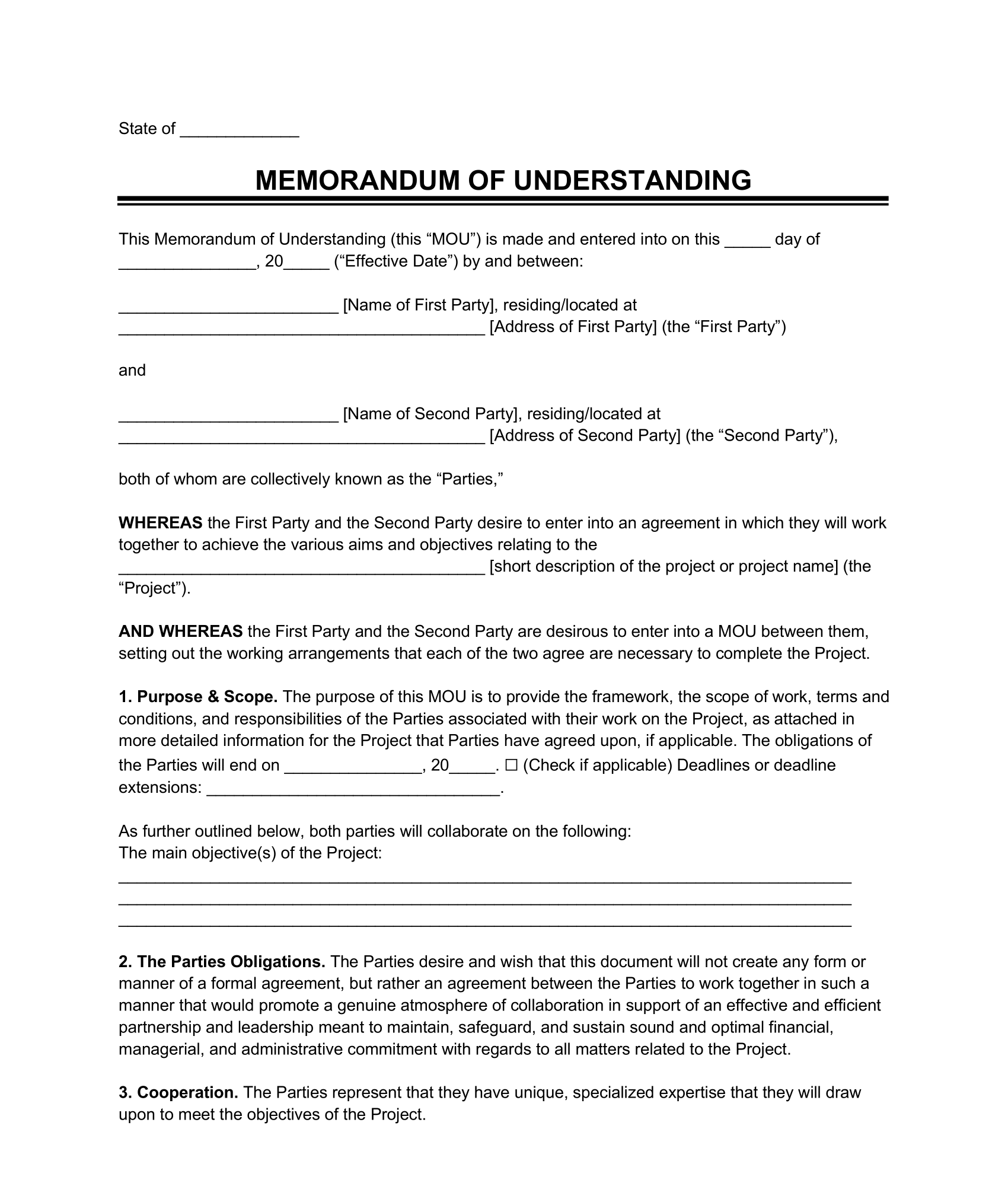
A typical MoU follows a simple and structured format that can be tailored to different partnerships. Below is a basic outline you can use as a reference.
MEMORANDUM OF UNDERSTANDING
This Memorandum of Understanding (this “MOU”) is made and entered into on this ______ day of ___________, 20________ (“Effective Date”) by and between:
_____________________________________ [Name of First Party], residing/located at
_____________________________________ [Address of First Party] (the “First Party”)
and
_____________________________________ [Name of Second Party], residing/located at
_____________________________________ [Address of Second Party] (the “Second Party”),
both of whom are collectively known as the “Parties,”
WHEREAS the First Party and the Second Party desire to enter into an agreement in which they will work together to achieve the various aims and objectives relating to the
_____________________________________ [short description of the project or project name] (the “Project”).
AND WHEREAS the First Party and the Second Party are desirous to enter into an MOU between them, setting out the working arrangements that each of the two agrees are necessary to complete the Project.
The purpose of this MOU is to provide the framework, the scope of work, terms and conditions, and responsibilities of the Parties associated with their work on the Project, as attached in more detailed information for the Project that the Parties have agreed upon, if applicable. The obligations of the Parties will end on ____________, 20________(Check if applicable) Deadlines or deadline extensions: ________________________.
As further outlined below, both parties will collaborate on the following:
The main objective(s) of the Project:
The Parties desire and wish that this document will not create any form or manner of a formal agreement, but rather an agreement between the Parties to work together in such a manner that would promote a genuine atmosphere of collaboration in support of an effective and efficient partnership and leadership meant to maintain, safeguard, and sustain sound and optimal financial, managerial, and administrative commitment with regards to all matters related to the Project.
The Parties represent that they have unique, specialized expertise that they will draw upon to meet the objectives of the Project.
While MoUs offer a practical way to begin a partnership, they also come with certain limitations:
| Advantages | Disadvantages |
| Clear Communication: Prevents misunderstandings. | Not Legally Binding: Cannot be enforced in court. |
| Flexibility: Easy to create and modify. | Ambiguity: Can lead to disputes if not drafted clearly. |
| Builds Trust: Shows serious commitment. | Risk of Non-Compliance: A party can back out without penalty. |
| Low Risk: A safe way to start a partnership. | May Create Unintended Obligations: Can be seen as a contract if not worded carefully. |
Connect with Startupease and let our experts handle
the legal hassle while you grow your business.