
Read More
India has emerged as one of the most promising destinations to invest in startups, driven by rapid digital growth and a large, young population. As per the Ministry of Commerce &...
File Form ADT-1 accurately and on time with Startupease. Get expert support to notify the ROC about auditor appointments as per MCA rules—fast, compliant, and stress-free.
 Timely Filing GuaranteedMCA-Approved Legal ExpertsAvoid Heavy PenaltiesTransparent Process & FeesTrusted by 5,000+ Businesses
Form ADT-1 is the required electronic filing that companies submit to the Registrar of Companies (ROC) to announce the appointment of their statutory auditor.
This form publicly identifies the auditor responsible for the company's financial statements and serves as the official notification to the Ministry of Corporate Affairs.
Under the Companies Act, 2013, the responsibility for filing this form shifted from auditors to companies themselves. Previously, auditors filed the appointment form (Form 23B) under the 1956 Act. This change places greater accountability on companies for their regulatory compliance.
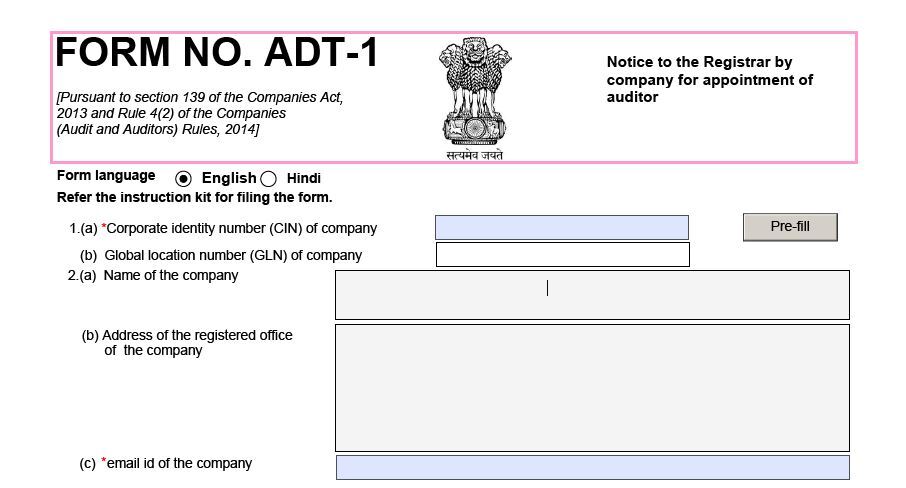
When filing the form, you must provide specific details about the auditor, each with a clear purpose:
The legal framework for auditor appointments and the filing of Form ADT-1 is primarily governed by:
It's crucial to understand that appointing an auditor and filing Form ADT-1 are two distinct steps. The appointment is the company's internal decision, while the form is the external notification to the government.
Think of it this way:
So, the role of the ADT-1 is purely to inform regulators. It makes sure the Ministry of Corporate Affairs (MCA) has a clear, updated record of who is auditing the company's finances. It's a critical compliance step after an auditor is appointed.
Appointing the first auditor is one of the earliest compliance steps that follows the incorporation of a private limited company or a business that chooses to register OPC online, ensuring financial transparency right from the start. The process involves a few key steps and mandatory filings, including the submission of Form ADT-1.
Here’s how the first auditor of a company is appointed, as per Section 139(6) of the Companies Act, 2013:
The ADT-1 filing requirement for the first auditor is not optional; it's a compulsory rule. Filing Form ADT-1 for the first auditor is a mandatory step under Section 139(1) of the Companies Act, 2013. This legal requirement highlights its importance.
Submitting this form within the set timeframe officially records the auditor's appointment with the MCA. Skipping this step is a direct violation and will lead to penalties (e.g., a fine ranging from ₹25,000 to ₹5,00,000 for the company under Section 147 of the Companies Act, 2013) for the company and its officers who are at fault.
After the first auditor's term ends (5 consecutive years), all subsequent auditors are appointed by the company's shareholders during the Annual General Meeting (AGM).
Filing the ADT-1 form isn't just a regulatory chore; it's a strategic move that underpins your company's stability and reputation. Here’s why:
Form ADT-1 must be filed by all companies, except Limited Liability Partnerships (LLPs), to officially inform the Ministry of Corporate Affairs (MCA) about the appointment of an auditor. Here's a breakdown of the entities that are required to file:
Note: LLPs are governed by a separate law (LLP Act, 2008) and are not required to file Form ADT-1.
To complete the ADT-1 filing, you will need the following key documents, which are attached to the e-form:
A written letter issued by the auditor clearly stating their willingness to accept the role of statutory auditor for the company.
The proposed auditor must provide a certificate confirming their eligibility as per Section 141 of the Companies Act, 2013. This certificate should declare that:
A copy of the resolution passed in the Board meeting or Annual General Meeting (AGM), approving the appointment of the auditor. This document should be signed and certified by an authorized officer or director of the company.
While not mandatory, attaching a copy of the formal appointment letter issued to the auditor adds credibility and helps clarify the terms of the engagement, such as the duration and remuneration.
The ADT-1 filing procedure is conducted online through the MCA V3 portal:
The ADT-1 is a mandatory form that must be filed within 15 days from the date of the auditor’s appointment. Here’s the detail of government fees, and if not submitted on time, companies are liable to pay additional fees and may face penalties under the Companies Act, 2013.
The standard filing fee for Form ADT-1 depends on the company’s authorised share capital. The higher the capital, the higher the fee. Here's the fee structure:
| Nominal Share Capital | Fee (INR) |
| Less than Rs. 1,00,000 | Rs. 200 |
| Rs. 1,00,000 to Rs. 4,99,999 | Rs. 300 |
| Rs. 5,00,000 to Rs. 24,99,999 | Rs. 400 |
| Rs. 25,00,000 to Rs. 99,99,999 | Rs. 500 |
| Rs. 1,00,00,000 or more | Rs. 600 |
Form ADT-1 is used to notify the Ministry of Corporate Affairs (MCA) about the appointment of a statutory auditor following the Companies Act, 2013. The form must be filed within a prescribed timeline, and its validity is linked to the auditor's term of appointment.
The deadline for filing Form ADT-1 depends on the type of auditor being appointed:
Illustration:
The validity of a filed Form ADT-1 aligns with the duration of the auditor’s appointment.
Filing Form ADT-1 is a legal requirement under the Companies Act, 2013. If a company does not file it within the due date, it can face penalties and other issues that may affect its operations and reputation.
Not filing ADT-1 on time goes against the law (Section 139 of the Companies Act). This can lead to legal action under Section 147.
The penalty for late filing of ADT-1 is severe and escalates with the delay. The law prescribes a flat penalty on the company and its officers, and the MCA imposes additional late filing fees on the form itself. The additional fee structure is as follows:
| Period of Delay | Additional Normal Filing Fee Payable |
| Up to 30 days | 2 times |
| More than 30 and up to 60 days | 4 times |
| More than 60 and up to 90 days | 6 times |
| More than 90 and up to 180 days | 10 times |
| More than 180 days | 12 times |
Example: If a company with Rs. 10 lakh authorised capital delays the filing by 100 days, the base fee is Rs. 400. Since the delay is over 90 days but under 180, the payable fee becomes Rs. 400 × 10 = Rs. 4,000.
In addition to the extra fee, non-compliance can attract penalties under Section 450 of the Companies Act, 2013. In such cases:
The company may be marked as “non-compliant” on the Ministry of Corporate Affairs (MCA) website. This status is visible to the public and can cause problems like:
If ADT-1 is not filed, the auditor's name won’t be updated in MCA records. This can lead to errors or rejection when you try to file other important forms like financial statements or annual returns.
Repeated delays or non-compliance may result in notices from the Registrar of Companies (ROC). It may also lead to inspections or deeper checks into the company’s activities.
Connect with Startupease and let our experts handle
the legal hassle while you grow your business.