Read More
India has emerged as one of the most promising destinations to invest in startups, driven by rapid digital growth and a large, young population. As per the Ministry of Commerce &...
Secure your sensitive business information with a professionally drafted Non-Disclosure Agreement tailored to your needs. Maintain confidentiality and safeguard your competitive edge. Start your NDA process today.
 Expert-drafted NDAs Compliant with Indian LawsProtects Confidential Business Data & Trade SecretsCustom Clauses Based on Your RequirementsPrevents Misuse of Sensitive InformationSeamless Online NDA Drafting
A Non-Disclosure Agreement (NDA), often called a confidentiality agreement, is a legally binding contract between two or more parties. In this agreement, the parties agree not to disclose confidential information shared between them for any purpose other than what's explicitly stated in the agreement.
Essentially, it creates a confidential relationship, ensuring that valuable business information, trade secrets, or proprietary data remains protected. Its purpose is to establish trust and provide legal recourse if that trust is breached.
Yes, in India, the terms "Non-Disclosure Agreement" and "Confidentiality Agreement" are largely interchangeable. They both serve the same fundamental purpose: to legally protect sensitive information.
While some might use "confidentiality agreement" more broadly to refer to a clause within a larger contract, when it stands alone as a separate document, it functions identically to an NDA. In the Indian legal context, both terms refer to the same type of protective legal agreement.
A Non-Disclosure Agreement is an essential tool for various individuals and entities in India.
Situations where an NDA is required are:
NDAs come in several forms. Understanding the different types helps you choose the right one for your situation.
| Type of NDA | Description | Typical Use Cases | Key Features |
| Unilateral NDA | One party discloses confidential information to another, who agrees to keep it secret | Employer–Employee, Startup–Investor | Only the receiving party is bound by confidentiality; simple and common for single-sided disclosure |
| — Employee NDA | Tailored for protecting the employer’s info shared with employees | Employee onboarding, contractors | Includes clauses on post-employment confidentiality and intellectual property rights |
| — Non-Compete NDA | Restricts the receiving party from competing in a similar market, alongside confidentiality | Employment contracts, business sales | Adds non-compete clauses enforcing market restrictions |
| — Project-Specific NDA | Confidentiality is limited to a particular project or deal | Specific product development, collaborations | Limits the scope and duration of confidentiality |
| Bilateral NDA (Mutual NDA) | Both parties exchange confidential information and agree to protect each other's info | Joint ventures, partnerships, mergers | Both parties have confidentiality obligations; protect shared information mutually |
| — Standstill NDA | Temporarily restricts parties from acting on disclosed info during negotiations | Negotiations, potential acquisitions | Prevents exploitation of info for a limited time during sensitive discussions |
| Multilateral NDA | Three or more parties share confidential info under one agreement | Consortia, complex collaborations | Streamlines confidentiality across multiple parties without multiple separate agreements |
| — Vendor/Supplier NDA | Usually falls under Unilateral or Mutual NDA, depending on information flow | Outsourcing, supply chain management | Covers the use and protection of sensitive product or process details by vendors |
To create an effective NDA, it's essential to include clauses that clearly define obligations and protections. Understanding these key elements is crucial.
Understanding the legal framework behind a Non-Disclosure Agreement in India is crucial for its enforceability.
Here are the key points regarding the legal side of NDAs in India:
| Aspect | Details |
| Governing Law | Indian Contract Act, 1872 |
| Legal Enforceability | NDAs are legally enforceable if they meet the essentials of a valid contract (offer, acceptance, etc.) |
| Mandatory Clauses | Definition of confidential information, obligations of the parties, duration, and remedies for breach |
| Stamp Duty Requirement | Varies by state. While an NDA's validity isn't always voided without stamp paper, it is crucial for enforceability as unstamped agreements are typically inadmissible in court. |
| Jurisdiction Clause | Specifies the courts that will have authority in case of disputes |
| Duration of Confidentiality | Can be for a fixed period or indefinite, depending on the nature of the information |
| Remedies for Breach | Injunctions (court orders to stop misuse), damages (financial compensation), or both |
| Admissibility in Court | Digitally signed or properly executed NDAs are admissible as evidence under the Indian Evidence Act |
| Use of Digital Signatures | Valid under the Information Technology Act, 2000 |
| Limitation Period | Parties must file a claim for breach within 3 years (under the Limitation Act, 1963) |
For the tech industry in India, a Non-Disclosure Agreement for an IT company has unique aspects to consider due to the nature of digital assets and data.
In IT, software, and app development, the most valuable assets are often intangible: source code, proprietary algorithms, database structures, and unique functionalities. A robust Non-Disclosure Agreement must explicitly define these as confidential information.
It should prevent reverse engineering, decompilation, or any unauthorized attempt to discover the underlying logic. This ensures that your intellectual property, which forms the core of your tech product, remains secure.
With the advent of the Digital Personal Data Protection Act (DPDP Act) in India, data privacy and security are paramount. A Non-Disclosure Agreement for an IT company should incorporate clauses that address data handling, storage, and processing, especially if personal data is involved.
It must ensure compliance with data protection laws, outlining the receiving party's obligations regarding data security, breach notification, and responsible data usage. This is a crucial feature for any modern NDA.
When collaborating on software or app development, it's vital to clearly define intellectual property ownership in the NDA. The agreement should state that any new IP developed using the Disclosing Party's confidential information belongs solely to the Disclosing Party, unless explicitly agreed otherwise.
This prevents potential disputes over ownership of newly created code, features, or designs, a key purpose of a Non-Disclosure Agreement in tech.
Here's a basic Non-Disclosure Agreement template for your reference. Please note that this is a sample and should be customized to your specific needs.
It's always advisable to consult with a legal professional to draft a comprehensive and legally sound Non-Disclosure Agreement document.
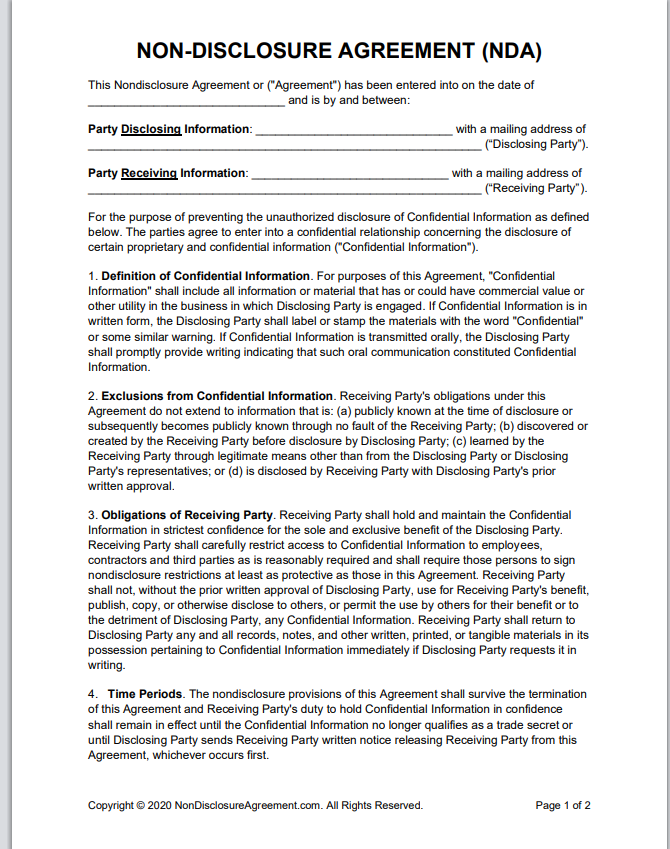
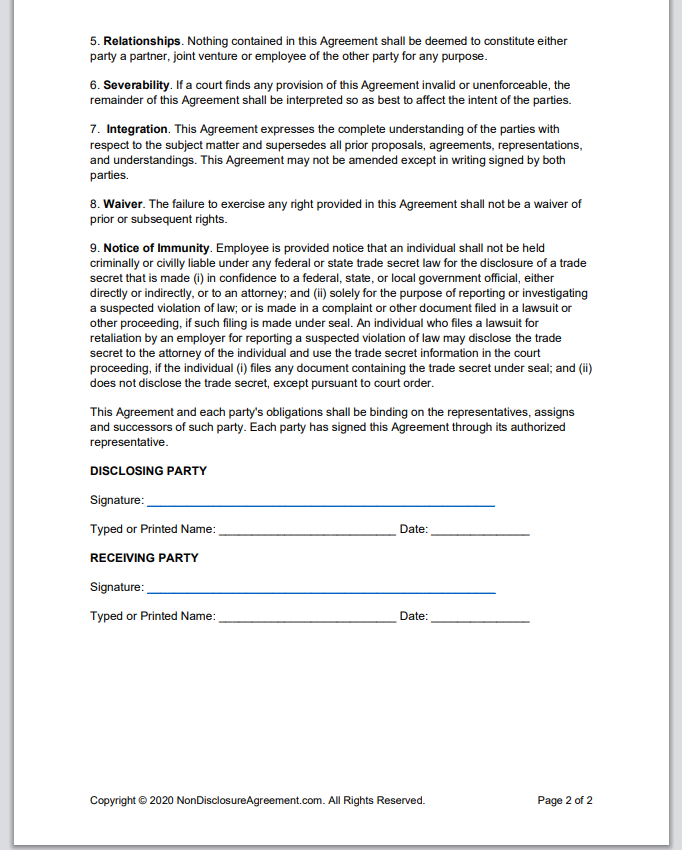
Non-Disclosure Agreement
This Non-Disclosure Agreement ("Agreement") is made and entered into on this [Day] day of [Month], [Year] ("Effective Date"),
BY AND BETWEEN:
[Disclosing Party's Full Legal Name/Company Name], a [Type of Entity, e.g., company incorporated under the Companies Act, 2013 / individual] having its registered office/address at [Disclosing Party's Address] (hereinafter "Disclosing Party");
AND
[Receiving Party's Full Legal Name/Company Name], a [Type of Entity, e.g., company incorporated under the Companies Act, 2013 / individual] having its registered office/address at [Receiving Party's Address] (hereinafter "Receiving Party").
(The Disclosing Party and the Receiving Party are hereinafter collectively “Parties” and individually “Party”)
WHEREAS:
NOW, THEREFORE, in consideration of the mutual covenants, the Parties agree as follows:
1. DEFINITION OF CONFIDENTIAL INFORMATION
"Confidential Information" means any non-public information, including but not limited to business plans, financial data, designs, software, source code, algorithms, trade secrets, research, customer lists, and intellectual property, whether oral, written, or electronic, disclosed by the Disclosing Party for the Purpose. Oral disclosures must be confirmed in writing by the Disclosing Party within [Number, e.g., fifteen (15)] days to be considered confidential.
2. PURPOSE
The Confidential Information is disclosed solely for [Clearly state the purpose, e.g., "evaluating a potential business collaboration," "developing a software application," "considering an investment opportunity," etc.] (the "Purpose").
3. EXCLUSIONS FROM CONFIDENTIAL INFORMATION
Confidential Information does not include information that:
4. OBLIGATIONS OF THE RECEIVING PARTY
The Receiving Party agrees:
5. TERM AND SURVIVAL
This Agreement is effective from the Effective Date until the Purpose concludes or either Party terminates it upon [Number, e.g., 30] days' written notice. Confidentiality obligations shall survive for [Number, e.g., five (5) years / perpetually for trade secrets] from the date of disclosure, notwithstanding termination.
6. RETURN OF INFORMATION
Upon written request or Agreement termination/expiry, the Receiving Party shall immediately cease using and, at the Disclosing Party's option, return or destroy all Confidential Information (including copies) and certify such action in writing.
7. CONSEQUENCES OF BREACH
The Receiving Party acknowledges that unauthorized disclosure causes irreparable harm. In case of breach, the Disclosing Party is entitled to seek injunctive relief (court order to stop disclosure) in addition to other legal or equitable remedies, including damages.
8. GOVERNING LAW AND JURISDICTION
This Agreement is governed by the laws of India. The Courts shall have exclusive jurisdiction over any disputes.
9. ENTIRE AGREEMENT
This Agreement constitutes the entire understanding between the Parties regarding its subject matter, superseding all prior communications.
IN WITNESS WHEREOF, the Parties have executed this Agreement as of the Effective Date first written above.
Contact a professional and get help drafting your NDA today!
To download your NDA:
To track your NDA request:
Connect with Startupease and let our experts handle
the legal hassle while you grow your business.