Read More
India has emerged as one of the most promising destinations to invest in startups, driven by rapid digital growth and a large, young population. As per the Ministry of Commerce &...
Gift Deed Registration ensures a legally valid and tax-efficient property transfer in India. Startupease offers expert support for accurate drafting, stamping, and registration—start the process online today.
 Legally Valid Gift Deed Drafting & ReviewStamp Duty Calculation & Payment AssistanceOnline Appointment Booking & Document HandlingCompliance with the Transfer of Property Act, 1882Trusted by 2,000+ Property Owners Across India
A gift deed is a legal document used to voluntarily transfer ownership of property, movable (like cash, jewellery, or shares) or immovable (like land or a house), from one person (the donor) to another (the donee) without any exchange of money. According to the Transfer of Property Act, 1882, the gift must be in writing, signed by the donor, and accepted by the donee during the donor’s lifetime. For it to be legally valid, it must also be registered.
Once registered, the donee becomes the legal owner of the property. While no payment is made, stamp duty and registration charges may still apply depending on the state and type of property. Under Section 56(2)(x) of the Income Tax Act, gifts from close relatives are tax-exempt, but gifts from non-relatives exceeding Rs. 50,000 in a year are taxable as income.
Key features:
A gift deed is a simple way to legally transfer property without involving money. Here’s why it’s useful:
Note: Gifts from relatives (as per the Income Tax Act) are tax-free, but gifts from non-relatives over Rs. 50,000 in a year are taxable as income.
To make a gift deed legally valid and clear, certain important details must be included in the document:
In India, a gift deed mainly focuses on the free and unconditional transfer of property, done out of love and affection, without taking any money in return. The deed should mention the people involved, property details, and other important terms to avoid legal issues later.
To make a gift deed legally valid and complete, it must include certain key clauses that clearly define the terms of the gift and protect the interests of both the donor and the donee.
Note: Although a gift deed is usually irrevocable, Section 126 of the Transfer of Property Act, 1882, allows revocation in specific cases.
Gift deeds in India are governed by a combination of laws to ensure that the transfer is legal, enforceable, and properly documented. These laws define how a gift should be executed, registered, and taxed:
Note: Gifts to non-relatives exceeding Rs. 50,000 are taxable in the hands of the receiver under Section 56(2)(x) of the Income Tax Act, 1961.
A gift deed lets you transfer movable or immovable property without taking any money in return. However, not every type of property can be gifted this way.
This includes land, houses, flats, or buildings. Transferring ownership of such property is very common, especially between family members.
Things like cars, jewellery, shares, and bonds fall under this category. Though less common, these items can also be gifted using a gift deed.
Note: When gifting shares, especially those of listed companies or private limited firms, the transfer may require SEBI compliance or adherence to company-specific regulations under the Companies Act.
Only property that the donor currently owns can be gifted. Future or expected property cannot be transferred through a gift deed.
Under Indian tax laws, gifting property to certain close relatives is allowed without attracting gift tax. These relatives include immediate family members such as:
Gifts given to these relatives are usually not taxed, making them eligible for tax-free property transfers through a gift deed.
Drafting a legally binding gift deed involves the following key steps:
Print the final draft on the non-judicial stamp paper of appropriate value and get it registered at the nearest registrar or sub-registrar’s office.
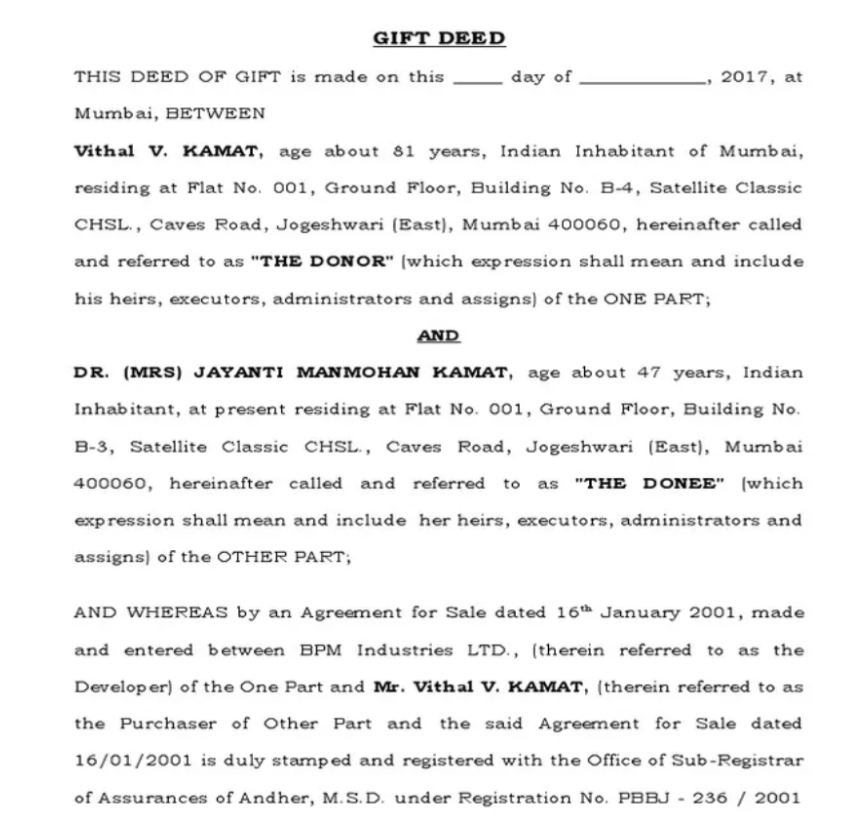
A Gift Deed is a legal document that allows a person to transfer ownership of property or assets to another person without taking any money in return. While gifting something might sound simple, it needs to follow certain legal rules to be valid.
To legally register a gift deed, certain documents must be submitted to prove the identity of the people involved and the ownership of the property. These documents help ensure that the gift transfer is valid and legally accepted.
Follow these easy steps to complete the gift deed registration process:
Before going to the registrar or sub-registrar’s office, make sure you have all the required documents ready. This includes the gift deed draft, proof of ownership, ID proofs of both donor and donee, and witness details.
Stamp duty is a government fee you must pay to register the gift deed. The amount depends on the location of the property, its value, and the rules set by the state government.
The donor, donee, and two witnesses must visit the registrar or sub-registrar’s office in person. The officer will check all documents, confirm the stamp duty has been paid, and make sure the gift deed is signed by everyone.
Once everything is verified, the office will officially register the deed and issue a registration certificate. This certificate acts as legal proof that the property has been gifted and the transfer is complete.
Note: In many states, stamp duty is concessional when gifting to blood relatives such as a spouse, children, or parents. Always check your state’s specific rules for applicable concessions.
The stamp duty and registration charges for registering a gift deed depend on the state where the property is located. Each state in India has different rates based on local rules and government policies.
Below is a list of stamp duty and registration charges for gift deeds in various Indian states:
| State | Stamp Duty | Registration Charges |
| Kerala | 2% | 1% |
| Tamil Nadu | 7% | 1% |
| Gujarat | 3.5% | 1% |
| Uttar Pradesh | 5% | 1% |
| Delhi | 6% | 1% |
| Rajasthan | 6% | 1% |
| Telangana | 0.5% | 1% |
| Maharashtra | 3% | 1% |
| West Bengal | 5% | 1% |
| Uttarakhand | 5% | 1% |
| Punjab | 6% | 1% |
| Bihar | 6% | 1% |
| Odisha | 3% | 1% |
| Jharkhand | 3% | 1% |
| Assam | 5.6% | 1% |
| Himachal Pradesh | 6% | 1% |
| Madhya Pradesh | 5% | 1% |
| Chhattisgarh | 5% | 1% |
| Chandigarh | 5% | 1% |
| Sikkim | 1% | 1% |
| Manipur | 7% | 1% |
| Arunachal Pradesh | 6% | 1% |
Note: These rates are subject to change and may also vary depending on the relationship between the donor and the donee.
For example, in Maharashtra, the stamp duty is only Rs. 200 when gifting to blood relatives, compared to 3% of market value in other cases.
In India, cancelling a gift deed is governed by Section 126 of the Transfer of Property Act, 1882. Once a gift deed is made, accepted, and put into effect, it usually cannot be cancelled. However, in some special situations, it can be revoked or cancelled.
The donor and donee can agree in advance that the gift will be cancelled if a particular event happens. But this condition should not depend only on the donor’s wish.
For example, both parties can agree that the gift will return to the donor if the donee passes away before the donor. This kind of condition is legally acceptable.
A gift deed can also be revoked if it was made through fraud, pressure, misrepresentation, or force, just like a contract can be cancelled in such cases. But unlike contracts, a gift deed cannot be cancelled just because there was no payment involved.
Note: It's also important to know that a gift cannot be cancelled simply because the donor changes their mind. The donor alone cannot take back the gift. That’s why, while drafting a gift deed, it’s very important to mention any conditions under which the gift can be cancelled. This helps avoid legal problems in the future.
Tip: While drafting a gift deed, always mention any revocation conditions explicitly. This helps prevent future legal disputes and ensures clarity between the parties.
In India, registering a gift deed is mandatory, especially when immovable property is involved. If a gift deed is not registered, it has no legal value and can lead to several problems:
A gift deed must be written on non-judicial stamp paper or e-stamp paper, which is available in some states. The value of this stamp paper depends on the state where the gift is being made and where the property is located. Each state in India has its own rules about the amount of stamp duty to be paid for a gift deed, so it should be checked as per the state’s guidelines.
Conditions for a valid transfer:
Connect with Startupease and let our experts handle
the legal hassle while you grow your business.