
Read More
India has emerged as one of the most promising destinations to invest in startups, driven by rapid digital growth and a large, young population. As per the Ministry of Commerce &...
File your GST returns online in India with Startupease. Get expert assistance with GSTR-1, GSTR-3B, GSTR-9, & ITC claims, ensuring timely, accurate, and compliant submissions every filing period.
 Monthly & Quarterly Filing SupportError-Free Submission & ReconciliationMaximize ITC with Expert ReviewDedicated GST ProfessionalsTrusted by 20,000+ Businesses & Individuals
A GST (Goods and Services Tax) return is an official document providing a comprehensive record of a business's financial activities. It provides a summary of sales and purchases, including the tax collected on sales (output tax) and the tax paid on purchases (input tax). Businesses must submit these returns electronically through the Government of India's official GST portal.
Under the GST regime, regular businesses with an annual aggregate turnover exceeding Rs. 5 crore are required to file two main monthly returns: GSTR-1 (details of outward supplies) and GSTR-3B (a summary return). In addition to these, most regular taxpayers must also file an annual return, bringing the total to as many as 25 returns per year for a monthly filer.
This process ensures compliance with tax regulations and forms the backbone of the Goods and Services Tax Network (GSTN). Even if a business has no activity during a tax period, filing a 'nil' return is mandatory to maintain compliance.
GST returns require detailed information on all sales and purchases of goods and services. Businesses report two key GST details: the GST they collect on sales (output GST) and the GST they pay on purchases, which they can claim as Input Tax Credit (ITC).
Key details required include:
| Category | Details to Submit |
| Basic Information |
|
| Outward Supplies (Sales) |
|
| Inward Supplies (Purchases) |
|
| Tax & Credit |
|
| Adjustments |
|
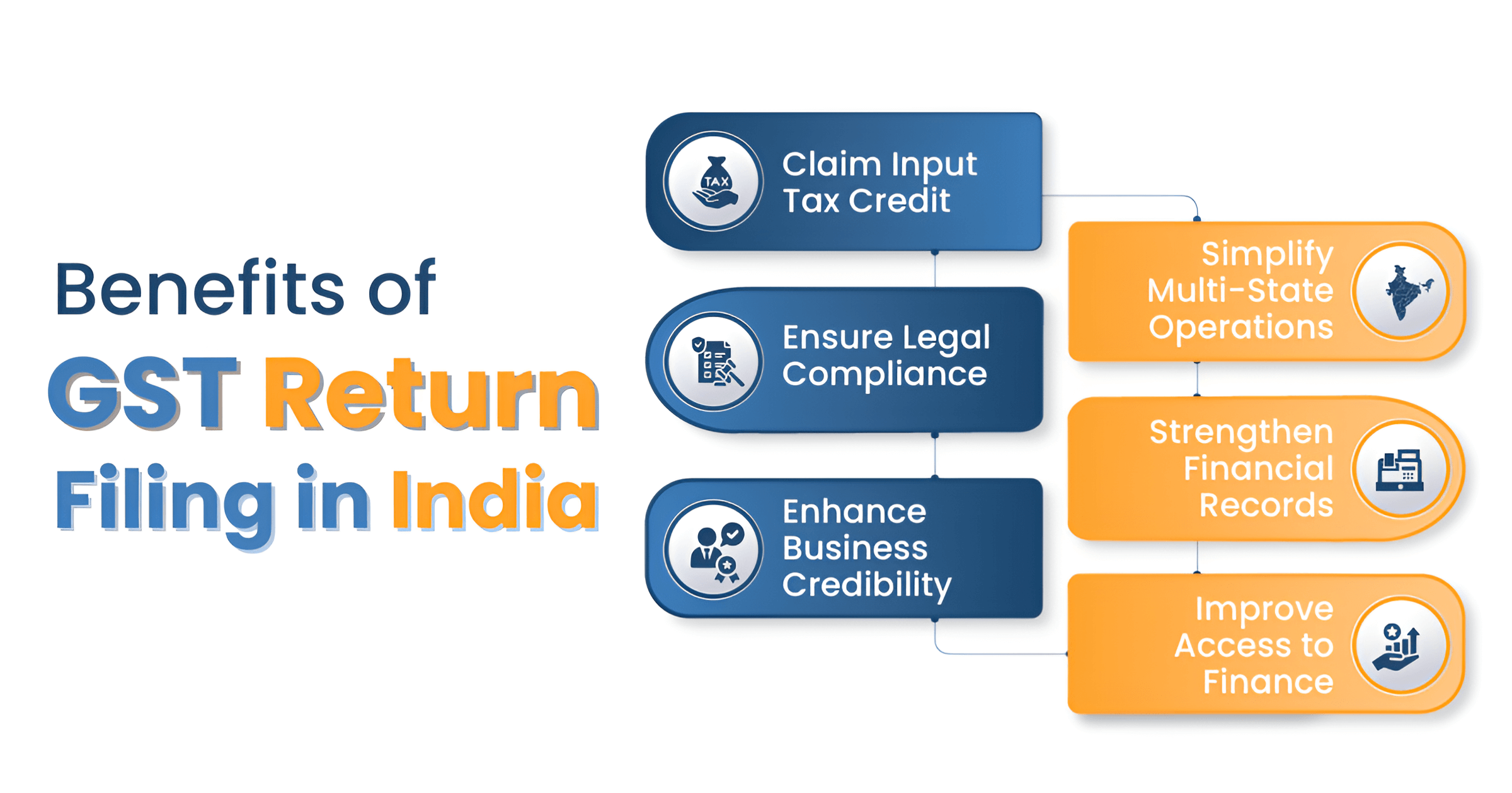
The GST system transformed India's indirect tax landscape in 2017 by replacing multiple central and state levies with a unified structure. This change required businesses to file regular GST returns to comply with tax regulations.
Here’s why GST Return Filing has evolved the Indian Tax System:
Filing GST returns within the specified deadlines is crucial to avoid financial penalties. Late filing incurs interest charges and late fees of up to Rs. 100 per day. Apart from avoiding fines, the return filing also presents a vital aspect of business operations and credibility.
Requirements for filing GST returns vary based on business turnover and type.
Every business registered under GST must file its returns regularly. The general thresholds for GST registration, which then mandate filing, are:
All normal taxpayers and casual taxpayers are required to file Form GSTR-3B.
Small traders with a yearly turnover of Rs. 1.5 Crores or less can opt for the Composition Scheme. This scheme simplifies GST compliance, allowing them to file a single annual return, GSTR-4. Additionally, they must file a simple challan in Form CMP-08 quarterly for tax payments.
It recognizes that a "one-size-fits-all" approach would be overly burdensome for micro and small enterprises.
Beyond general businesses, specific entities have distinct GST filing obligations:
While most registered businesses must file GST returns, certain situations or entities may have specific exemptions or simplified requirements.
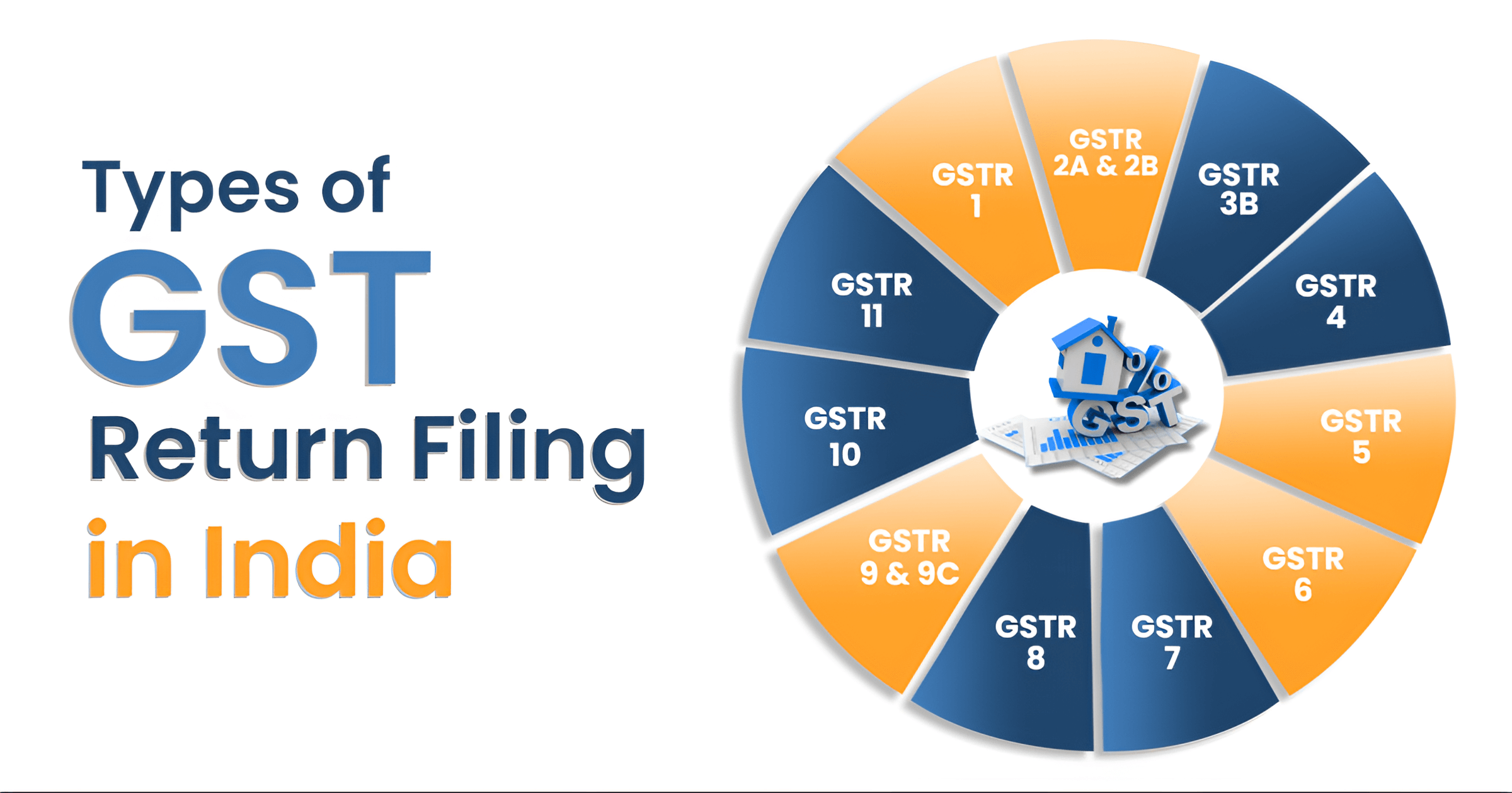
While there are a total of 13 different GST return forms, not all apply to every business. GST returns are primarily structured into monthly, quarterly, and annual filings, depending on the taxpayer's Aggregate Annual Turnover (AATO) and business type.
Businesses with an annual turnover exceeding Rs. 5 crore are generally required to file monthly returns, specifically GSTR-1 (outward supplies) and GSTR-3B (summary return). This frequency ensures faster Input Tax Credit (ITC) claims and smoother compliance for high-volume businesses.
Businesses with an annual turnover of up to Rs. 5 crore can choose to file GST returns quarterly under the Quarterly Return Monthly Payment (QRMP) scheme. Under this scheme, taxpayers file GSTR-3B quarterly but pay tax monthly.
They also have the option to file GSTR-1 monthly or quarterly. This reduces the compliance burden for Micro, Small, and Medium Enterprises (MSMEs).
All regular taxpayers must file an annual return, GSTR-9, by December 31st of the next financial year. Composition scheme taxpayers file GSTR-4 annually.
The variety of GST returns caters to different taxpayer categories, ensuring tailored compliance requirements:
| Return Type | Applicable To | Purpose | Frequency | Due Date |
| GSTR-1 | Regular Taxpayers | Report outward supplies and tax liability | Monthly/Quarterly | 11th (monthly) / 13th (quarterly) of next month |
| GSTR-2A | Regular Taxpayers | Auto-drafted purchase return (dynamic) | Auto-generated | Ongoing (view-only) |
| GSTR-2B | Regular Taxpayers | Static monthly purchase return with ITC info | Auto-generated Monthly | 14th of next month |
| GSTR-3B | Regular Taxpayers | Summary of sales, ITC, and tax payable | Monthly/Quarterly | 20th / 22nd / 24th of next month (based on state) |
| GSTR-4 | Composition Scheme Taxpayers | Annual return declaring turnover and tax paid | Annually | 30th April of the following FY |
| CMP-08 | Composition Scheme Taxpayers | Statement for self-assessed tax payment | Quarterly | 18th of the month following the quarter |
| GSTR-5 | Non-Resident Taxable Persons | Report taxable supplies and tax payable | Monthly | 20th or within 7 days of business closure |
| GSTR-6 | Input Service Distributors (ISD) | Distribute ITC to branches | Monthly | 13th of the following month |
| GSTR-7 | TDS Deductors | Report tax deducted and credits to deductees | Monthly | 10th of the following month |
| GSTR-8 | E-commerce Operators | Report supplies made and TCS collected | Monthly | 10th of the following month |
| GSTR-9 | Regular Taxpayers | Annual return summarizing GSTR-1 & 3B | Annually | 31st December of the following FY |
| GSTR-9C | Businesses with turnover > Rs. 5 crore | Audit & reconciliation statement | Annually | 31st December of the following FY |
| GSTR-10 | Taxpayers with Cancelled GSTIN | Final return post cancellation | One-time | Within 3 months of cancellation |
| GSTR-11 | UIN Holders (e.g., Embassies) | Claim GST refund on inward supplies | Monthly | 28th of each month |
The GST Council has consistently introduced measures to simplify the GST return filing process, aiming to ease compliance, especially for small businesses. Key initiatives include:
These steps reduce filing frequency and minimize errors in reporting. Additional simplifications include:
Taxpayers can also amend returns to correct errors, helping avoid penalties.
To file GST returns online, taxpayers need a GST Identification Number (GSTIN) and a registered account on the official GST portal. Here is a step-by-step guide to filing GST returns online:
Visit the official GST website (gst.gov.in). Enter your GSTIN, username, and password. Complete the CAPTCHA verification and click "Login".
Navigate to the 'Services' tab, then click on 'Returns' and select 'Returns Dashboard'. Choose the financial year and the relevant return filing period (month/quarter). Select the appropriate GST return form (e.g., GSTR-1, GSTR-3B).
Fill in details of your sales (outward supplies), purchases (inward supplies), input tax credit (ITC), and tax liabilities. Make sure all details are accurate before uploading, as any errors can result in penalties.
Upload invoices for outward supplies in the prescribed format. If applicable, add invoices for purchases to claim Input Tax Credit (ITC).
Cross-check all entered details before submission. The system may auto-calculate the tax payable after ITC adjustment.
If there is any net tax liability, proceed with the payment. You can pay using multiple options like net banking, debit/credit card, NEFT/RTGS, or UPI.
Click on 'Submit' to freeze the return data. Once submitted, no further changes can be made for that period. Complete verification using a Digital Signature Certificate (DSC) (mandatory for companies/LLPs) or an Electronic Verification Code (EVC) (OTP sent to registered mobile number).
After successful filing, an Application Reference Number (ARN) is generated, and an acknowledgment receipt can be downloaded for records.
Essential documents required for GST return filing include:
Adhering to GST return filing due dates is critical to avoid penalties and maintain compliance. The due dates vary based on the type of return and the taxpayer's turnover.
This table outlines common GST return filing due dates:
| GST Return Name | Filing Frequency | Due Date |
| GSTR-1 | Monthly | 11th of the next month |
| GSTR-1 | Quarterly (QRMP Scheme) | 13th of the month succeeding the quarter |
| GSTR-3B | Monthly | 20th of the next month |
| GSTR-3B | Quarterly (QRMP Scheme) | 22nd or 24th of the month succeeding the quarter (depending on state) |
| GSTR-4 | Annually | 30th of the month succeeding the financial year (from FY 2024-25, it's April 30th) |
| GSTR-5 | Monthly (Non-resident taxpayers) | 13th of the next month (amended by Budget 2022, yet to be notified) |
| GSTR-6 | Monthly (ISD) | 13th of the next month |
| GSTR-7 | Monthly (TDS Deductors) | 10th of the next month |
| GSTR-8 | Monthly (E-commerce Operators) | 10th of the next month |
| GSTR-9 / GSTR-9C | Annually | 31st December of the next financial year |
| GSTR-10 | Once (Final Return) | Within 3 months of the cancellation date or order |
| CMP-08 | Quarterly (Composition Levy) | 18th of the month succeeding the quarter |
| ITC-04 | Annually/Half-yearly | 25th April / 25th October |
Note: Due dates are subject to changes by CBIC notifications/orders.
Failing to submit GST returns on time incurs financial penalties, including late fees and interest.
Failure to file GSTRs for six continuous months can lead to the suspension and potential cancellation of GST registration.
Taxpayers can track their GST return filing status online through the official GST portal using various options.
The Application Reference Number (ARN) is a unique 15-digit code received after submitting a GST application or return. It confirms that the GST system has received the application.
To track using ARN:
This method allows checking the status of all returns filed within a specific timeframe.
To track using the filing period:
This method allows filtering returns by their current processing status.
To track using status:
Taxpayers can easily download their filed GST return forms from the official GST portal for record-keeping and verification purposes.
Here are the steps to download GST return forms:
Past GST return forms can be accessed by selecting the relevant financial year and return period on the "Returns Dashboard".
Connect with Startupease and let our experts handle
the legal hassle while you grow your business.