Read More
India has emerged as one of the most promising destinations to invest in startups, driven by rapid digital growth and a large, young population. As per the Ministry of Commerce &...
Register your LLP online in India from 1,999 + govt fees. Startupease manages name approval, MCA filing, LLP agreement, PAN, TAN, DSC & DIN end-to-end — with CA/CS-verified accuracy and 10–15 day turnaround.
 Fast Registration in 10–15 DaysName Approval, MCA Filing & Incorporation CertificateDSC, DIN, PAN & TAN RegistrationLLP Agreement Drafting & Compliance SupportTrusted by 50,000+ Startups & Entrepreneurs
LLP registration is the process of legally incorporating a Limited Liability Partnership under the LLP Act, 2008, through the Ministry of Corporate Affairs (MCA). It gives your business a separate legal identity and limited liability, so partners' personal assets stay protected from business debts, while you keep the operational flexibility of a partnership. A registered LLP receives a Certificate of Incorporation with a unique LLPIN as proof of its legal existence.
The Limited Liability Partnership Act, 2008, is the legislation that governs the formation, operation, and regulation of LLPs in India. Enacted by the Parliament of India and brought into force on 31st March 2009, this Act introduced a hybrid business structure that combines the flexibility of a traditional partnership with the limited liability protection of a private limited company.
Unlike traditional partnerships, an LLP:
Currently, LLPs are mainly favored by startups and professionals who seek shared management, reduced compliance, and legal protection without risking personal assets.
LLP registration in India follows legal rules that ensure the proper setup and operation of these business entities.
| Parameter | LLP | Private Limited | Partnership Firm |
|---|---|---|---|
| Governing law | LLP Act, 2008 | Companies Act, 2013 | Partnership Act, 1932 |
| Liability | Limited | Limited | Unlimited |
| Separate legal entity | Yes | Yes | No |
| Min. members | 2 partners | 2 directors | 2 partners |
| Audit | Only if turnover > ₹40L / contribution > ₹25L | Mandatory | Not mandatory |
| Compliance burden | Low | High | Very low |
| Best for | Professionals, SMEs, service firms | Startups raising funds | Small informal businesses |
Before we get into how to incorporate an LLP, let’s first know about the many options available to register as one. These forms of LLP registration come in various types to accommodate different categories of businesses and operational needs:
For businesses operating within India with Indian partners.
Example: Two chartered accountants in Delhi forming an LLP to provide accounting services across India.
For LLPs with foreign partners or foreign LLPs establishing a place of business in India.
Example: A UK-based consulting firm establishing an LLP in India with both Indian and British partners.
For professionals such as chartered accountants, company secretaries, and lawyers, etc.
Example: A group of architects forming an LLP to offer architectural design services.
For innovative business ventures seeking recognition under the Startup India initiative.
Example: Three engineers forming an LLP to develop a new mobile application with innovative features.
For businesses with lower turnover and capital contribution thresholds.
Example: A small manufacturing business with a turnover of less than Rs. 40 lakhs forming an LLP.
For existing partnerships or private limited companies converting to the LLP structure.
Example: An existing partnership firm dealing in textiles converting to an LLP structure for limited liability benefits.
A recent provision allows single-member LLPs for a limited period, specifically six months in certain cases.
Example: A sole proprietor converting their business into an LLP under special provisions.
Every registered LLP receives a Certificate of Incorporation as official proof of registration.
Before starting the LLP registration process, it’s important to check whether your business meets the eligibility criteria under the Limited Liability Partnership Act, 2008.
To register an LLP in India, the following conditions must be fulfilled:
1. Minimum partners - At least two partners are required to form an LLP (individuals or bodies corporate).
2. Designated Partners - Minimum two designated partners who are individuals, with at least one being a resident of India.
3. Residency Requirement - At least one designated partner must have resided in India for at least 182 days during the preceding year.
4. Age requirement - All partners and designated partners must be at least 18 years of age.
5. No maximum limit - There is no maximum limit on the number of partners in an LLP.
6. Digital Signature Certificate (DSC) - All designated partners must possess a valid DSC.
7. Director Identification Number (DIN) - All designated partners must have a valid DIN or DPIN.
8. Prohibited sectors - LLPs cannot be registered for non-profit activities or in sectors prohibited by the government.
Meeting these statutory and financial requirements necessitates proper LLP company registration in India to maintain compliance and avoid penalties.
Before starting online LLP registration, ensure all required documents are ready for smooth incorporation and faster approval. The required documents are as follows:
The LLP registration process involves several legal and procedural steps. Understanding these steps can help ensure a smooth and compliant LLP registration online in India.
Getting a Digital Signature Certificate (DSC) is mandatory for all designated partners as they are required to sign electronic documents being submitted to the MCA portal. It acts as a digital key to authenticate the partner's identity online.
DSCs can be obtained from licensed Certifying Authorities such as eMudhra, Sify, or NSDL.
Every designated partner of an LLP must have a DIN for their official recognition. A DIN can be obtained by filing the Form DIR-3, along with the PAN, photograph, and address proof through the MCA portal. The application is digitally signed using the applicant’s DSC.
Once the application is approved, the MCA generates a unique DIN, which is valid for the entire tenure of the LLP.
Every LLP must have a unique name before incorporation, approved by the MCA. Name reservation is done through the RUN-LLP form. You can file up to six name options in order of your preference. The names must comply with MCA guidelines and not match existing LLPs, companies, or trademarks.
You can check the company name availability for your LLP to avoid any conflict.
Submit Form FiLLiP (Form for Incorporation of Limited Liability Partnership) along with necessary documents, including the Subscriber sheet and consent of a Director (Form DIR-9). The Subscriber Sheet is signed by the first partners to confirm their agreement to form the LLP.
It also shows the initial ownership structure of the firm.
The LLP Agreement is a legal document that governs the internal functioning of the LLP. Draft and file a detailed LLP Agreement through Form 3 on the MCA portal within 30 days of incorporation. The agreement should outline partners’ rights, duties, profit-sharing ratios, and other key terms.
It ensures clarity among partners and serves as a reference for resolving disputes.
Upon successful verification, the Registrar issues a Certificate of Incorporation (COI). The certificate confirms the LLP's existence with its own LLP Identification Number (LLPIN), registered office address, and details of partners. With the COI, the LLP gains legal recognition to start its business in India.
After incorporation, the LLP must comply with several post-registration formalities. It must obtain a PAN, TAN, open a bank account, register for GST (if applicable), and file Income Tax Return using ITR 5. Additionally, annual filings of Form 11 (Statement of Account & Solvency) and Form 8 (Annual Return) on the MCA portal are also mandatory.
After the process is completed, you should apply for GST registration for your firm.
An LLP Registration Number, also known as the Limited Liability Partnership Identification Number (LLPIN), is a unique 7-digit alphanumeric code issued by the Registrar of Companies (ROC) upon incorporation. This number serves as the official identity of the LLP and is required for all filings and communications with the ROC. Once the applicant completes the registration process and submits the necessary documents, the ROC issues the Certificate of Incorporation containing the LLPIN as proof of registration.
Example of LLPIN: AAA-1234
An LLP Incorporation Certificate is the official document issued by the MCA that confirms the successful registration of a Limited Liability Partnership. proves the LLP’s legal existence, granting it a separate identity to operate, open a bank account, enter into contracts, and more. The certificate is essential for all legal, financial, and compliance-related activities and should be securely stored.
With the MCA’s online system, obtaining this certificate is quick and convenient, and it can be downloaded easily using your registration details after approval.
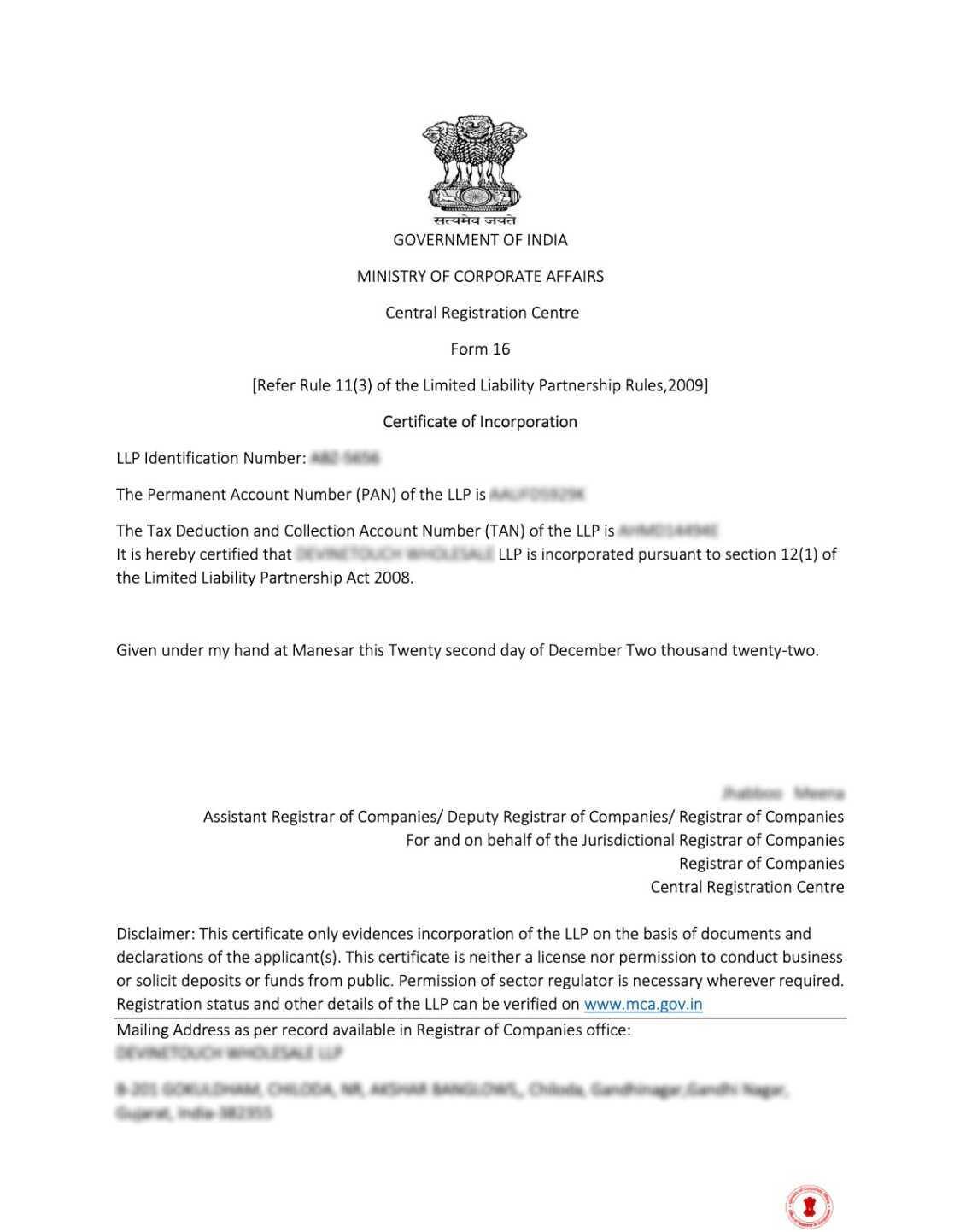
To download your LLP Incorporation Certificate:
To check your LLP registration status:
LLP registration online usually takes around 10 to 15 working days, depending on how quickly you submit documents, how soon the name is approved, and how efficiently the government processes the application.
With professional assistance, the timeline can often be reduced through error-free and streamlined submission.
Key Timeline Breakdown:
Note: Timeline may vary based on case complexity, document verification, and government workload.
Understanding the total cost of LLP registration in India, including government fees, professional charges, and potential penalties, is essential for entrepreneurs.
Registration costs for LLPs vary based on the capital contribution and professional services required for accurate submission.
Note: The fees mentioned above don’t cover the charges an LLP registration consultant might take for their services.
Penalties and consequences for incorrect or delayed LLP registrations and compliance can include fines, interest charges, and legal action, depending on the severity of the issue.
For the complete fee details, read our comprehensive guide on LLP registration fees in India.
Registering an LLP is only the first step; maintaining it requires strict compliance with the Limited Liability Partnership Act, 2008, and the filing rules prescribed by the Ministry of Corporate Affairs (MCA). Every LLP registered with the Registrar of Companies (ROC) must fulfil a set of annual and event-based filing obligations, failing which penalties apply with no upper cap. At Startupease, we ensure your LLP never misses a deadline.
LLPs registered in India must file the following with the MCA each financial year:
Certain changes within the LLP trigger immediate filing obligations with the ROC:
Keeping your LLP compliant protects you from penalties, maintains your legal standing with the ROC, and builds trust with partners, clients, and investors.
Ignoring LLP compliance leads to escalating penalties and legal consequences:
Non-compliance also creates barriers to obtaining bank loans, entering into contracts, attracting investors, or winding up the LLP in the future.
Not sure if an LLP is the right business structure for you? Here are the key benefits of LLP registration in India, including limited liability protection, tax advantages, and flexible business operations:
An LLP is the right fit for professionals and small/medium service businesses that want liability protection with minimal compliance. If your priority is raising external equity, consider Startupease Private Limited Company Registration service, as this business structure is generally preferred by investors and venture capital firms.
An LLP registration has distinct characteristics that shape how these business entities function:
Still exploring your options? You might also want to check out our Company Registration services.
Connect with Startupease and let our experts handle
the legal hassle while you grow your business.